Showing posts with label Heart. Show all posts
Showing posts with label Heart. Show all posts
2009/07/18
Legos Again
[This is an update of an earlier post, "Happy Boom Day".] I ended up buying my daughter two Lego sets. One is a basic set of blocks, which comes in a blue plastic box with a lid, wherein the tiny, cat-attracting Legos may be safely stored so as to prevent loss, or "shrinkage" as Wal-Mart calls loss (I have worked at Wal-Mart, in produce, and I hope never to work at any Wal-Mart ever again, but I digress). The second set is part of Lego’s "City" milieu; essentially, sets that, when put together, form a functioning Lego city. I bought a set of people. They include a deliveryman with a hand-truck; a woman with a ghetto blaster; a uniformed policeman with a megaphone, white hat, walkie-talkie, and a mustache; and one fellow who I can describe only as being a liberal arts professor, given the appearance of his hair, sweater vest, neck tie, full beard, and a briefcase. The city people set also comes with a traffic signal, three road signs, a park bench, and a fireplug (all of the latter must be assembled). It’s delightful! We’ve had great fun swapping the people’s hair. The professor wears the woman’s hair (which I assume is "Princess Hair") and she wears the professor’s hair ("Prince Hair"?). A bit later, Liz bought yet a third Lego set, a Front-End Loader, which comes with another Legoman. This one is a construction worker in an orange jumpsuit. He has a rough beard and a sly expression. He resembles an escaped prisoner. The Front-End Loader kicks ass. You can scoop things with it; namely, a pile of small Lego bricks. Thus far I have built many Lego vehicles of questionable utility. They generally have oversized tires and as many lights and funnels and tubelike devices attached to them as I can add.
2009/07/04
Happy Boom Day
My daughter is making the transition from toddler-Legos ("Duplo" blocks; or, oversized blocks) to the tiny, miniscule, easily lost, cat-attracting Lego blocks which we all know and love. She has two sets: The Krusty Krab (featuring Spongebob, Mr. Krabs, and Patrick Star Legomen) and a dump truck set (an oversized ore-hauler truck with two Lego boulders and a driver Legoman). She is playing with them in the den as I write. The cats are congregating therein.
 Boo.
Boo.
The temptation to purchase more of these Lego sets tickles my pleasure center every day. (She just brought me the Krusty Krab to reassemble after the roof broke off somehow.) You should see some of the Lego sets available nowadays! One can purchase, for example, the Millenium Falcon Lego set, which has over 5,000 pieces (including Chewbacca!), for $500.00. Who would buy this toy which is obviously not meant to be played with? Also available is the Death Star (yes, Death Star) set, not quite as grandiose as the Millenium Falcon, but costing about $350.00 nonetheless.
No. For my daughter I’m thinking much smaller-scale in terms of cost and number of tiny pieces. I’ll admit this as well: I want to play with them too. I love Legos. I’ve never been able to build anything except with Legos or words. I am inept when it comes to construction, carpentry, putting together, taking apart anything generally. No good at it. Easily frustrated. Annoyed!
At the website you can order entire sets. Also you can order individual pieces, "bricks", as every piece apparently is called: "Beard for Mini Figure", "Bat", "Brick 1x6", "Brick 2x2", "Brick 2x2 White Dec.Eyes", "Brick W. Shaft 1X8x1", "Camera", "Cherry", "Circular Saw", "Corrugated Pipe 16Mm, Black", "Croissant", "Crossbow" [21 cents!], "Dragon’s Fire", "Dustbin", "Flat Tile 2x2", "Flower Transparent", "Flying Goggles", "Head for Skeleton" [24 cents], "Left Roof Tile 2x3", "Left Shell 2x6 W. Bow Angle", "Life Jacket", "Megaphone", "Metal Detector" [24 cents], "Mini Body Lower Part" [in black, white, blue, red, or green; blue and red cost 35 cents while the other colors cost 31 cents, for some reason], "Mini Cape", "Mini Head" [14 varieties, including a transparent Head, ranging in price from 8 cents to 24 cents], "Mini Upper Parts", "Mini Wig Man", "Parabola 6x6", "Plate 1x10", "Plate 2x10", "Plate 2X4x18°", "Plate 8x8", "Pneumatic Hammer", "Princess Hair", "Quiver", "Rim Narrow W. Hole Ø8", "Rim Wide W.Cross 30/20", "Rocket Step 4X4x2", "Roof Tile 1X1x2/3, Abs", "Roof Tile 1X2x3/73°", "Round Brick 1x1", "Round Plate 1x1", "Skater Helmet", "Skeleton Body W. Shaft 3.2", "Snowy Owl", "Space Skeleton Arm", "Spear", "Spider", "Swim Fins", "Technic Brick 1x8", "Tyre Low Wide Ø37 X 22", "Undercarriage 2X2x2", "Wall Corner 1X1x1", "Whip", "Wig Boy", "Wig, Ponytail", "Windscreen 2X4x2", and others among a total of 1,491 individual bricks. One can purchase accessories for cars; hardware; lumber; corpses, skulls, and body parts; deadly weapons; tools; food; animals; fire; rocket components; new identities; and a whole host of amenities. From nowhere else can you find and purchase such a broad range of things, legal or otherwise.
So anyway, I’m tempted to buy another set for my daughter. By which I mean: for my daughter and myself...I would like to buy skeleton heads, Mini Upper Parts, Mini Wigs, Mini Body Lower Parts, various Mini Helmets, tools, swim fins, spears, Princess Hair, and the like...Maybe I should just stick to a set.
 Boo.
Boo.2009/05/26
My Critical Introduction: A Young Draft
This is a reflection on process. The writing process in general, and the process of writing this collection. They are one and the same. I have neither time nor patience nor space to offer comfort, encouragement, good cheer, or humorous anecdotes. Writing is an obsession both time- and mind-consuming. Little else provokes more aggravation. That is what you will find here: aggravation. There are no comfort zones. Those who write from comfort address only their ego, and egos love attention.
Once you have written all your stories (or poems, essays, etc.), you start again, and write anew. Those who write for awhile and then give up are left with resources they haven’t helped to destroy. Material (or Subject Matter) is used up, re-used, always-already destroyed and regained, reprocessed. Everything has been done. Nothing has not been left undone. This is very simple to understand. Stretching for pure originality in writing dooms you to frustration, at best; failure, at worst. If you have something to write, then write it. If you believe you have nothing to write, or nothing new to write, then you won’t write a word. And that’s okay with me.
I will focus on story-writing process. Stories require two basic attributes: Spine and Heart. First comes Spine, the logical structure (or framework) of sense. A story without a Spine is nonsense: when you read a Spineless story, you become lost, confused, frustrated, aggravated, annoyed, or so thoroughly amused by the bad writing that you will never again bother to read that particular author’s work.
Spineless stories have these and possibly other qualities: Character behavior seems unbelievable, ridiculous, absurd. Events happen for little or no apparent reason. Abstractions abound. Narrative focuses on redundancies, irrelevancies, everyday tediums. Narrative time runs out of control. The text contains numerous and obvious typos, glitches, unnecessary verb tense shifts, misspellings, and the like. When you read it, you have no idea what is going on.
I think of a story as a human body. Without a Spine, the body is paralyzed, almost useless. The human body cannot function without a Spine. (Stories do not have the luxury of wheelchairs, respirators, or physical therapists.) The human body can survive without arms and legs, without hair, without eyes, without a tongue, without sex organs; the human body can survive with only half of one lung, or with one half-functional kidney. But a Spine is a requirement. The Story’s text must be clear, without glitches or typos or bizarre constructions of grammar. The Story needs to make sense when read; characters can do things that make no sense, but in ways that make sense to the reader. Nouns and Verbs make sense to the reader. Simple sentence structures make sense to the reader. Stout Anglo-Saxon words make sense to the reader. Concrete images hold the reader’s attention. Clearly delineated time keeps track of events, and reinforces the sense of a world with laws and rules. The reader should not need to pause (to look up some obscure Latinate word, to computate a pile of adjectival phrases, to translate misspellings and other grammatical glitches). When the reader can read through without stopping, and afterward knows at minimum what is going on in the Story, then the Story has a functioning Spine.
The presence of a functioning Spine makes a story, but not a good story. The best stories have not only Spine, but Heart.
[Forthcoming: Heart . . .]
Once you have written all your stories (or poems, essays, etc.), you start again, and write anew. Those who write for awhile and then give up are left with resources they haven’t helped to destroy. Material (or Subject Matter) is used up, re-used, always-already destroyed and regained, reprocessed. Everything has been done. Nothing has not been left undone. This is very simple to understand. Stretching for pure originality in writing dooms you to frustration, at best; failure, at worst. If you have something to write, then write it. If you believe you have nothing to write, or nothing new to write, then you won’t write a word. And that’s okay with me.
I will focus on story-writing process. Stories require two basic attributes: Spine and Heart. First comes Spine, the logical structure (or framework) of sense. A story without a Spine is nonsense: when you read a Spineless story, you become lost, confused, frustrated, aggravated, annoyed, or so thoroughly amused by the bad writing that you will never again bother to read that particular author’s work.
Spineless stories have these and possibly other qualities: Character behavior seems unbelievable, ridiculous, absurd. Events happen for little or no apparent reason. Abstractions abound. Narrative focuses on redundancies, irrelevancies, everyday tediums. Narrative time runs out of control. The text contains numerous and obvious typos, glitches, unnecessary verb tense shifts, misspellings, and the like. When you read it, you have no idea what is going on.
I think of a story as a human body. Without a Spine, the body is paralyzed, almost useless. The human body cannot function without a Spine. (Stories do not have the luxury of wheelchairs, respirators, or physical therapists.) The human body can survive without arms and legs, without hair, without eyes, without a tongue, without sex organs; the human body can survive with only half of one lung, or with one half-functional kidney. But a Spine is a requirement. The Story’s text must be clear, without glitches or typos or bizarre constructions of grammar. The Story needs to make sense when read; characters can do things that make no sense, but in ways that make sense to the reader. Nouns and Verbs make sense to the reader. Simple sentence structures make sense to the reader. Stout Anglo-Saxon words make sense to the reader. Concrete images hold the reader’s attention. Clearly delineated time keeps track of events, and reinforces the sense of a world with laws and rules. The reader should not need to pause (to look up some obscure Latinate word, to computate a pile of adjectival phrases, to translate misspellings and other grammatical glitches). When the reader can read through without stopping, and afterward knows at minimum what is going on in the Story, then the Story has a functioning Spine.
The presence of a functioning Spine makes a story, but not a good story. The best stories have not only Spine, but Heart.
[Forthcoming: Heart . . .]
2009/05/15
Code of Chivalrous Conduct
1. Honor and Defend thy Writing Time. 2. That which cannot Distract, will not. 3. Knowing before you begin to write, that which shall occupy your Writing Time, prevents you from wasting energy in Indecision. 4. Leave your Writing only for that which is essential to your needs. 5. When the Writing cannot move, cannot progress, read from that which moves you. 6. Mood is sacred. Before and during Writing Time, avoid news, websites, blogs, email. 7. Never forget: No Story [or poem, or essay] Comes in a Day. 8. Should you violate your code, you may be the only person who knows; but, that knowledge shall weigh on your conscience. 9. No subject is so taboo as not to be committed to paper. 10. Never forget your family.
2009/03/18
Distraction, Heart . . . Writings from Nine Months Ago
Characters who suffer Distraction may know full well in what they invest their attention. Consider the slipperiness of prepositions: do characters suffer from Distraction or with Distraction or because of Distraction? Similarly, are characters themselves the source of Distraction or the victims of Distraction or is Distraction something (at? to? on? in? for? by? toward? through? across?) which characters give attention?
I should pay attention to Distraction, not to distractions, in whatever form they manifest, but to Distraction itself.
*
How can one distract one's distraction?
*
Distraction. Loss. A sense of outrage. An inability to think rationally and clearly. A grasping at quick fixes that do not fix, and are not quick. A demand for immediate satisfaction of desires, of wants, of success. (Does desire know only gift and theft?) The chasing of happiness, when happiness itself is unknown and undefinable. What the hell is it? "Happy" cannot exist as a verb. It needs a helper: to make, to be, to become. Or it needs an active verb: to pursue, to chase, to grab, to forget, etc.
*
What about thumbtacks? The empty aquarium? The lava lamp that’s missing its base? What things have Heart? Does a bead have Heart? A bead has Heart. A bead’s heart is its hole, through which a twine strings together one bead with other beads, a string of Heart. A bead without its hole is not a bead, but a marble, a pebble, a bit of glass, something else. But not a bead.
---
Absence is Heart. A treasure ceases to be treasure once it is no longer valued. An empty aquarium, aquarium though it may be, contains absence, it contains something that is not there. A shoe without a foot. A ring without a finger. A day without pain.
---
Does a gun have a Heart? Does a bullet count? Does a will, a want, a desire? Is there Heart in an action: picking up a gun in a moment of passion? Throwing down a gun before a fight has begun? Agreement to the use of force by action of the force itself. Disagreement to the use of force by action of dropping the gun. Is there Heart in fear? Fear that is felt by bystanders, preservation, an impulse not toward action but toward words, paralysis. Prayer? Is prayer action or words or both?
---
In Heart lies desire. What truth is in the statement "Desire knows only theft and gift"? What does Heart know? Does Heart know theft? Gift? Absence? Does the hole through a bead desire twine?
---
"So What?" and "Defamiliarization" share something in common. What is it? A new perspective of an old thing. A different understanding of something thoroughly understood. A sensory experience of something that offers no sensory stimulation.
---
What am I seeking? The language of excess. The language of distraction. The language of stories, and myths, and narratives. The language to move readers. The language to argue, to convey, to understand, to escape. The language of characterization.
---
Listen to the background noise, the hiss and chime behind vertical surfaces. What do you hear? How do you hear it?
I should pay attention to Distraction, not to distractions, in whatever form they manifest, but to Distraction itself.
*
How can one distract one's distraction?
*
Distraction. Loss. A sense of outrage. An inability to think rationally and clearly. A grasping at quick fixes that do not fix, and are not quick. A demand for immediate satisfaction of desires, of wants, of success. (Does desire know only gift and theft?) The chasing of happiness, when happiness itself is unknown and undefinable. What the hell is it? "Happy" cannot exist as a verb. It needs a helper: to make, to be, to become. Or it needs an active verb: to pursue, to chase, to grab, to forget, etc.
*
What about thumbtacks? The empty aquarium? The lava lamp that’s missing its base? What things have Heart? Does a bead have Heart? A bead has Heart. A bead’s heart is its hole, through which a twine strings together one bead with other beads, a string of Heart. A bead without its hole is not a bead, but a marble, a pebble, a bit of glass, something else. But not a bead.
---
Absence is Heart. A treasure ceases to be treasure once it is no longer valued. An empty aquarium, aquarium though it may be, contains absence, it contains something that is not there. A shoe without a foot. A ring without a finger. A day without pain.
---
Does a gun have a Heart? Does a bullet count? Does a will, a want, a desire? Is there Heart in an action: picking up a gun in a moment of passion? Throwing down a gun before a fight has begun? Agreement to the use of force by action of the force itself. Disagreement to the use of force by action of dropping the gun. Is there Heart in fear? Fear that is felt by bystanders, preservation, an impulse not toward action but toward words, paralysis. Prayer? Is prayer action or words or both?
---
In Heart lies desire. What truth is in the statement "Desire knows only theft and gift"? What does Heart know? Does Heart know theft? Gift? Absence? Does the hole through a bead desire twine?
---
"So What?" and "Defamiliarization" share something in common. What is it? A new perspective of an old thing. A different understanding of something thoroughly understood. A sensory experience of something that offers no sensory stimulation.
---
What am I seeking? The language of excess. The language of distraction. The language of stories, and myths, and narratives. The language to move readers. The language to argue, to convey, to understand, to escape. The language of characterization.
---
Listen to the background noise, the hiss and chime behind vertical surfaces. What do you hear? How do you hear it?
2009/03/11
Spine & Heart (Process VIII)
I am agreeable to a fantastic story. Ten years I spent playing Dungeons & Dragons, among other role-playing games. Now I’m not too surprised about having gone on study stories in college (and if I had more time, I’d be playing those games in my spare hours). Dungeons & Dragons allows a small group to create individual characters who interact with a fictional world. It is, quite simply, world-building & characterization & plot development & narrative structure & willing suspension of disbelief all wrapped together in an ongoing storyline with numerous minor storylines branching off and back again over an extended period of time. Almost invariably I served as "game master." The world was my own. All things and creatures and personae and Gods and characters (except for the players’ characters) were my own. It is a living thing. It has voice and reason, myth and tales, heroes and dragons. It is a place of horrible violence where bad things happen to good people and good things happen to bad people. As it must necessarily be so. And, it was good practice.
Onward.
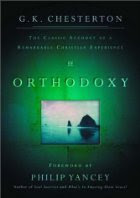
Have any of us read Orthodoxy by G.K. Chesterton? I am reading this book again (third or fourth time) because I feel my writing has stagnated. Oh I’m producing. I’m writing habitually. But something is stuck. Something in the writing isn’t moving. There is no reason to go out of my way (and out of my wits) to identify what that something is. These somethings happen to us all.
Anyhow. I won’t explain Orthodoxy or summarize it. (To do so would cheapen the experience of reading it for the first time.) Though I will leap into worthwhile passages that have helped me to understand more deeply the Process.
In "The Ethics of Elfland" Chesterton explains the difference between the Reasonable, Necessary logic of actions in actuality and the possibility of the same Reasonable, Necessary logic of actions in fairyland. He is explaining the relationship of what I call "Heart and Spine."
Spine: the structure of literal sense that is necessary for a reader to be able to read the story (analogous to Mathematics, or the Letter of the Law). Without Spine, the story cannot move; it is paralyzed. The narrative has no mobility, no legs to walk on, no arms to wave, no fingers with which to gesture. Without Spine, the processes necessary for a narrative body to do anything cannot happen.
Heart: the figurative and emotional sense that is necessary for a reader to be able to relate to the story (analogous to the Spirit of the Law). Without Heart, the story may as well be a technical schematic, a complex algebraic equation, a health insurance policy. Without Heart, the story lacks emotion as well as the means of carrying the weight of emotion through language.
"The test of fairyland [is] the test of the imagination" (69). For example: "The witch in a fairy tale says, ‘Blow the horn, and the ogre’s castle will fall’; but she does not say it as if it were something in which the effect obviously arose out of the cause. Doubtless she has given the advice to many champions, and has seen many castles fall, but she does not lose either her wonder or her reason. She does not muddle her head until it imagines a necessary mental connection between a horn and a falling tower."
In narrative, Heart embodies mystery. Spine does not. But Spine is necessary in order to understand the story at all. With paralysis the Heart may or may not go on beating; regardless, it is lost to us. When we read the story of a witch who tells a champion, "Blow a horn, and the ogre’s castle will fall", if we immediately stop to question the witch ("Why must the champion blow a horn? That doesn’t make sense. What he needs to do is raise an army, or find some way to trick the bastard, or hire someone else to do the dirty work...etc.), then we destroy the mystery. We rip the Heart out of the story and squeeze the life out of it. The witch’s advice is part of the mystery. The witch herself is part of the mystery. No one can explain it definitively. There is no denotation. You can define what mystery itself is, but you cannot explain any given mystery. That is the Heart of a story. The Thing-in-Itself cannot be explained. And of course, if we rip out the Heart, the Spine becomes a mere spine, a structure without purpose. A structure for the sake of itself. Of what use is such a thing?
Onward.
Have any of us read Orthodoxy by G.K. Chesterton? I am reading this book again (third or fourth time) because I feel my writing has stagnated. Oh I’m producing. I’m writing habitually. But something is stuck. Something in the writing isn’t moving. There is no reason to go out of my way (and out of my wits) to identify what that something is. These somethings happen to us all.
Anyhow. I won’t explain Orthodoxy or summarize it. (To do so would cheapen the experience of reading it for the first time.) Though I will leap into worthwhile passages that have helped me to understand more deeply the Process.
In "The Ethics of Elfland" Chesterton explains the difference between the Reasonable, Necessary logic of actions in actuality and the possibility of the same Reasonable, Necessary logic of actions in fairyland. He is explaining the relationship of what I call "Heart and Spine."
Spine: the structure of literal sense that is necessary for a reader to be able to read the story (analogous to Mathematics, or the Letter of the Law). Without Spine, the story cannot move; it is paralyzed. The narrative has no mobility, no legs to walk on, no arms to wave, no fingers with which to gesture. Without Spine, the processes necessary for a narrative body to do anything cannot happen.
Heart: the figurative and emotional sense that is necessary for a reader to be able to relate to the story (analogous to the Spirit of the Law). Without Heart, the story may as well be a technical schematic, a complex algebraic equation, a health insurance policy. Without Heart, the story lacks emotion as well as the means of carrying the weight of emotion through language.
"The test of fairyland [is] the test of the imagination" (69). For example: "The witch in a fairy tale says, ‘Blow the horn, and the ogre’s castle will fall’; but she does not say it as if it were something in which the effect obviously arose out of the cause. Doubtless she has given the advice to many champions, and has seen many castles fall, but she does not lose either her wonder or her reason. She does not muddle her head until it imagines a necessary mental connection between a horn and a falling tower."
In narrative, Heart embodies mystery. Spine does not. But Spine is necessary in order to understand the story at all. With paralysis the Heart may or may not go on beating; regardless, it is lost to us. When we read the story of a witch who tells a champion, "Blow a horn, and the ogre’s castle will fall", if we immediately stop to question the witch ("Why must the champion blow a horn? That doesn’t make sense. What he needs to do is raise an army, or find some way to trick the bastard, or hire someone else to do the dirty work...etc.), then we destroy the mystery. We rip the Heart out of the story and squeeze the life out of it. The witch’s advice is part of the mystery. The witch herself is part of the mystery. No one can explain it definitively. There is no denotation. You can define what mystery itself is, but you cannot explain any given mystery. That is the Heart of a story. The Thing-in-Itself cannot be explained. And of course, if we rip out the Heart, the Spine becomes a mere spine, a structure without purpose. A structure for the sake of itself. Of what use is such a thing?
2009/03/01
A Selection: 20 minutes of Elocution, by my Daughter
IT’S JUST A LETTER FOR MAMA. OH, THAT’S JUST MY TRUCK DOWN THERE. AND LOOK WHAT I MADE. IT’S CALLED THE FISH COLLECTION. IT LOOKS SO GREAT IN THIS. HERE’S THE CAR. HERE’S SOMETHING. WE ALWAYS HAVE SKIN. WE NEED TO HAVE DOG FOOD DOWN HERE. AND CAT FOOD. BABY, I’M GOING TO DECORATE IT WITH CLAM SHELLS. DON’T GET ANY IDEAS. GETTING UNDER MY SKIN! BOMBS AWAY! BOUNCE AWAY! OH, TAD, BACK SO SOON? BUT REMEMBER, WATCH OUT FOR THE GHOST OUTSIDE. IS IT TIME TO ROLL? NO, I’M STANDING ON THE TABLE BECAUSE IT’S FLYING. I SEARCH HIGH AND LOW. MY CAP. YOU MEAN THAT I’M TURNING MY ELBOWS BACKWARDS. YOU MEAN I HAVE NO HANDS. I HAVE NO ELBOWS LIKE AN ALIEN. IT LOOKS LIKE A BUBBLE. IF YOU TURN IT UPSIDE-DOWN IT LOOKS LIKE A BUBBLE. I DON’T WANT HIM. I WANT MY LITTLE DOG. I’LL BE RIGHT BACK INSIDE. WHEN I WAS SCRATCHING MY HAND . . . YUM. BACK SO SOON? HEY, MAKE THIS A RIVER! I’M LAUGHING IN THE RIVER! FIRST, WE GET TO SHARE THE PLAY-DOH. WELL LET’S PLAY BABIES RIGHT HERE. WE’RE HERE. PROFESSOR PICKLES. AND I’M PLAY-DOH KITTY. NO I’M PLAY-DOH DOG.
*
[Recorded by hand on the evening of 28 February, 2009. Medium: Crayola markers on yellow college-rule legal pad.]
*
You can't make this stuff up.
*
[Recorded by hand on the evening of 28 February, 2009. Medium: Crayola markers on yellow college-rule legal pad.]
*
You can't make this stuff up.
2009/02/18
Play Areas
In the mall there is a crossroads, between Barnes & Noble and Scheel’s, and in this crossroads there is a great circle. The circle has but one opening, an ingress point at which stands Dr. Bear in all its loveable menace. The bear wears a doctor’s coat but not pants. Just inside the circle, on either side of the opening, there are cubby holes, ostensibly for the storage of children’s footwear, and a single hand-sanitizer dispenser. Padded benches line the circle’s low wall most of the way around. The carpet is spongy, but firm. Around a necessary structural pillar a padded mat has been attached like a bootie. And of course the playthings themselves: an ambulance, a thermometer, a stethoscope, a blood pressure cuff, a Band-aid, a building in the likeness of the Mankato Clinic, and a teddy bear the size of a great big fat man. The playthings are made of a pliable material both soft and firm. Everything in the circle rebounds, with the exception of the cubby holes and the structural pillar itself.
Watching a rampage of children play in the arms of the circle is like looking into a moshpit from balcony seats, except no one is smoking cigarettes or drinking beer or wearing earplugs. Adults behave no differently from children as far as I can tell. The distinction is that adults have learned how to control themselves to various extents. Among children, drama unfolds quickly, plays itself out, and soon evolves into another game. Adults squeeze drama out of drama, drama out of rocks, drama out of thin air. It is refreshing how quick children are to judge, like cats. How many times has the play area carpet been puked on? The absence of visible stains suggests that puking incidents are quickly cleaned up, rarely happen in the play area, or do not happen in the play area.
My sister would tell you a story about me, when I was seven years old. I had just eaten a bowl of cherry cordial ice cream. I shouted, "I’m a human vacuum cleaner!" and instantly fell on the carpet in complete imitation of the vacuum cleaner. In a matter of seconds I had inhaled something, a piece of fluff or fuzz, on which I choked. Coughing didn’t help much, not right away. The fluff or fuzz stuck long enough to teach me a lesson, and then I threw up all the ice cream I had just eaten, on the carpet I was attempting to clean. Why am I telling you this?
2009/02/15
Merken - To Notice...Subtle, Subtlety, etc.
Yesterday, February 14, marked a significant date: 8 years since Liz and I first met. Though not face-to-face. Our first contact with one another happened over the internet, in a chat room, and later progressed to letters in the mail and hours-long phone conversations. This went on for six months until we did meet in person, after I rode a Grayhound bus from Carbondale, IL to Austin, TX (a 23-hour trip). Someday I will write this story, but not today.
---
Recently I have thought about two questions, or rather, a question and a statement. (I don’t know why these have come to mind, they just kind of bubbled to the surface while I was taking a shower.) They are the sort of commentary one hears in workshops and in poor-quality reviews and criticism:
"It seems as though the author is trying to be subtle."
"What point is the author trying to make?"
How is subtlety a bad thing? When do authors write anything with a conscious desire to effect subtlety? Is a clear understanding of "subtle" (adjective) warranted? Should we sort through the word’s many denotations?
[Oxford English Dictionary]
1. Of thin consistency, tenuous; not dense, rarefied; hence, penetrating, pervasive or elusive by reason of tenuity (now chiefly of odors).
2. Of fine or delicate texture or composition (Obs. exc. Arch.). b. Of food: delicate, light. (Obs.)
3. Of small thickness or breadth; thin, slender, fine. (Obs.) b. Of a ship. (Obs.)
4. Finely powdered; (of particles) fine, minute. (Obs.)
5. Of immaterial things: not easily grasped, understood, or perceived; (Obs.:) intricate, abstruse. (Now merged in sense 6).
6. Fine or delicate, especially to such an extent as to elude observation or analysis.
7. Of craftsmen, etc.: Skillful, clever, expert, dextrous. (Const. of) arch. b. transf. c. Of animals. rare.
8. Of things: characterized by cleverness or ingenuity of conception of execution; cleverly designed or executed, artfully contrived. (Obs.)
9. Of persons, their faculties, actions: Characterized by penetration, acumen, or discrimination. Now with implication of (excessive) refinement or nicety of thought, speculation, or argument.
10. Of persons or animals: Crafty, cunning; treacherously or wickedly cunning, insidiously sly, wily. (Obs.) b. Of actions, thoughts, etc. (Obs.) c. Of ground: tricky. (Obs.)
11. Working imperceptibly or secretly, insidious.
12. Of weight: = subtile (Obs.)
Also, "Subtlist" (noun):
One who is addicted to subtleties.
Also, "Subtlize" (verb):
Rare. Intransitive. To indulge in subtleties.
Ah, the verb "(to) subtle" (Obs.):
1. Reflexive and Intransitive. To devise subtleties or subtle distinctions, to argue subtly.
2. Intransitive. To scheme, plan craftily. Also with clause.
3. Transitive. To devise cleverly.
4. To attenuate, reduce.
5. ? To pulverize, reduce to ashes. nonce-use.
I understand that what I am doing is devising subtleties and making subtle distinctions; I am also, perhaps, indulging in subtleties. But how is "subtle" a word to be used in a pejorative sense? How?
---
"Subtle" cannot be subtle with a b.
---
Recently I have thought about two questions, or rather, a question and a statement. (I don’t know why these have come to mind, they just kind of bubbled to the surface while I was taking a shower.) They are the sort of commentary one hears in workshops and in poor-quality reviews and criticism:
"It seems as though the author is trying to be subtle."
"What point is the author trying to make?"
How is subtlety a bad thing? When do authors write anything with a conscious desire to effect subtlety? Is a clear understanding of "subtle" (adjective) warranted? Should we sort through the word’s many denotations?
[Oxford English Dictionary]
1. Of thin consistency, tenuous; not dense, rarefied; hence, penetrating, pervasive or elusive by reason of tenuity (now chiefly of odors).
2. Of fine or delicate texture or composition (Obs. exc. Arch.). b. Of food: delicate, light. (Obs.)
3. Of small thickness or breadth; thin, slender, fine. (Obs.) b. Of a ship. (Obs.)
4. Finely powdered; (of particles) fine, minute. (Obs.)
5. Of immaterial things: not easily grasped, understood, or perceived; (Obs.:) intricate, abstruse. (Now merged in sense 6).
6. Fine or delicate, especially to such an extent as to elude observation or analysis.
7. Of craftsmen, etc.: Skillful, clever, expert, dextrous. (Const. of) arch. b. transf. c. Of animals. rare.
8. Of things: characterized by cleverness or ingenuity of conception of execution; cleverly designed or executed, artfully contrived. (Obs.)
9. Of persons, their faculties, actions: Characterized by penetration, acumen, or discrimination. Now with implication of (excessive) refinement or nicety of thought, speculation, or argument.
10. Of persons or animals: Crafty, cunning; treacherously or wickedly cunning, insidiously sly, wily. (Obs.) b. Of actions, thoughts, etc. (Obs.) c. Of ground: tricky. (Obs.)
11. Working imperceptibly or secretly, insidious.
12. Of weight: = subtile (Obs.)
Also, "Subtlist" (noun):
One who is addicted to subtleties.
Also, "Subtlize" (verb):
Rare. Intransitive. To indulge in subtleties.
Ah, the verb "(to) subtle" (Obs.):
1. Reflexive and Intransitive. To devise subtleties or subtle distinctions, to argue subtly.
2. Intransitive. To scheme, plan craftily. Also with clause.
3. Transitive. To devise cleverly.
4. To attenuate, reduce.
5. ? To pulverize, reduce to ashes. nonce-use.
I understand that what I am doing is devising subtleties and making subtle distinctions; I am also, perhaps, indulging in subtleties. But how is "subtle" a word to be used in a pejorative sense? How?
---
"Subtle" cannot be subtle with a b.
2009/01/08
There are an infinite number of ways . . .

More things in life ought to be made of Play-Doh. If you disagree, then you are wrong. Look at these tools! They are made to resemble octopus arms. They cut, they roll, they impress patterns in the soft clay. Unfortunately, once a multicolored amalgation of different Play-Dohs has been created, the colors are impossible to separate.

Three-dimensional shapes are both a challenge and a delight! Imagine a green Stonehenge. Imagine a purple cityscape, complete with cellular towers. Imagine neon-blue palm trees on a dinosaur-infested beach.

And, in case you missed seeing it, here is the snow.
2008/12/02
I have no title
A girl in Florida recently underwent a heart transplant. Before the operation, she survived for two months without a heart inside her body. The doctors kept her alive. Despite all the problems with the health and medical professions in this country (chiefly, the problems of for-profit service industry and insurance middlemen), the determination of those doctors to keep the girl alive, aware, conscious, with no heartbeat in her chest, while waiting for a viable donor heart, is nothing short of a gift.
***
Characters in stories are real, as real as movie actors, as real as commercial actors, as real as you and I in our day-to-day lives. Characters in stories suffer for a reason: so we can observe and say, "I'm glad my life's not that bad." By necessity, characters in stories suffer. They embody all aspects of our own actual existence so that we can experience our own flaws, failures, shortcomings, our own tiny moments of light, hope, success, and triumph through another's experience of them. In that way story characters are sacrificial, whether they are aware of it or not. By writing them, we give them life. By witnessing them, we share in the experience of that life.
Subscribe to:
Posts (Atom)