Showing posts with label reading. Show all posts
Showing posts with label reading. Show all posts
2009/10/31
2009/07/31
Updated: Books
What books were available have been laid claim to. The rest shall appear at the Blue Earth County Library on the paperback exchange shelf. I am quite fond of the paperback exchange. Sometimes you just can't give books away because nobody wants them. I don't know what happens to the books I leave at the library but I can only assume that people snatch them. Most of the books I find there are romance paperbacks, mass-market westerns, and the like. I leave literary journals, quality works by quality authors, hardback novels; books, I hope, that people are eager to find and eager to read.
In his essay "Hermes Goes to College" (Upstreet #4), Michael Martone advocates Stealing Things In: making your own books and leaving them in libraries, airports, cafes; in short, any place where lots of people might find your book, pick it up, and take it. And why not? "I point out to [my students], that they have to distribute their books as well, that libraries and bookstores have elaborate apparati to prevent you from stealing a book out of their stacks but they have nothing to guard against you stealing your work into the bookstore or the library. And that's what they do, shelving their own work or leaving it to be shelved, allowing the librarian to affix the catalog number, enter it into inventory."
Now, one problem I'll soon have is what to do with my glut of role-playing game books. I know I can sell some of them; I will keep some of them as well; but the rest, you almost can't give some of them away. Any ideas?
In his essay "Hermes Goes to College" (Upstreet #4), Michael Martone advocates Stealing Things In: making your own books and leaving them in libraries, airports, cafes; in short, any place where lots of people might find your book, pick it up, and take it. And why not? "I point out to [my students], that they have to distribute their books as well, that libraries and bookstores have elaborate apparati to prevent you from stealing a book out of their stacks but they have nothing to guard against you stealing your work into the bookstore or the library. And that's what they do, shelving their own work or leaving it to be shelved, allowing the librarian to affix the catalog number, enter it into inventory."
Now, one problem I'll soon have is what to do with my glut of role-playing game books. I know I can sell some of them; I will keep some of them as well; but the rest, you almost can't give some of them away. Any ideas?
2009/07/25
Waiting on Rejections
I have become accustomed to editors rejecting my work. I don’t mind. I don’t blame them. Sometimes the work just isn't good enough. There’s always a better story or ten or a hundred ahead of mine in the queue. What I haven’t grasped yet is the wait to receive the rejection. Here’s why.
The longest wait I’ve had so far has been about three months (generic review X). The shortest wait I’ve had has been about twenty hours (generic magazine Y). It took generic review X three months to reject one story; generic magazine Y rejected not only that same story but a second one, with a personalized note for the second, in about twenty hours. Both journals are not among the littlest guys; each has been around a while, has a significant presence, and is accessible via such sites as Duotrope and the CLMP.
Among the easiest things in the world to do is to read the first dozen lines of a story from a slushpile, see that said story is (incomprehensible / syntactically sloppy / a first draft / hackneyed / insert various other flaws here), and reject it. A dozen manuscript lines might take about 30 seconds to read, another two seconds to sneer at, and another ten seconds to secure in the NO pile (or shunt to the NO folder in a database). Let’s say a story a minute. A determined editor who knows how to read and knows what a quality story looks like could eliminate fifty stories in an hour; one-hundred stories in two hours. (No excuses. It could be done.)
I know that generic magazine Y did read, in full, the second story that I submitted; the personal rejection letter proves it. Someone took a lot of time and energy to reject me very quickly, and made sure to let me know they did.
What are the discrepancies between one journal’s sloth and another journal’s celerity? Some requirement to read the entire body of each story? Quotas? The use of graduate student labor? Volunteerism? Intrajournal politics and disagreement? Can anyone explain this, or am I pondering something entirely disagreeable that no human being should ever think about?
The longest wait I’ve had so far has been about three months (generic review X). The shortest wait I’ve had has been about twenty hours (generic magazine Y). It took generic review X three months to reject one story; generic magazine Y rejected not only that same story but a second one, with a personalized note for the second, in about twenty hours. Both journals are not among the littlest guys; each has been around a while, has a significant presence, and is accessible via such sites as Duotrope and the CLMP.
Among the easiest things in the world to do is to read the first dozen lines of a story from a slushpile, see that said story is (incomprehensible / syntactically sloppy / a first draft / hackneyed / insert various other flaws here), and reject it. A dozen manuscript lines might take about 30 seconds to read, another two seconds to sneer at, and another ten seconds to secure in the NO pile (or shunt to the NO folder in a database). Let’s say a story a minute. A determined editor who knows how to read and knows what a quality story looks like could eliminate fifty stories in an hour; one-hundred stories in two hours. (No excuses. It could be done.)
I know that generic magazine Y did read, in full, the second story that I submitted; the personal rejection letter proves it. Someone took a lot of time and energy to reject me very quickly, and made sure to let me know they did.
What are the discrepancies between one journal’s sloth and another journal’s celerity? Some requirement to read the entire body of each story? Quotas? The use of graduate student labor? Volunteerism? Intrajournal politics and disagreement? Can anyone explain this, or am I pondering something entirely disagreeable that no human being should ever think about?
2009/07/17
Habits
I am awash in bad habits. Sometimes I eat too much. This can elevate my blood-sugar. High blood-sugar makes me sleepy. I’ve been sleeping too much lately. Not tomorrow though. Tomorrow I refill another prescription for long-acting Vyvanse (12-hour speed). I have gone without these pills for more than a week. Withdrawl symptoms reinforce bad habits, it’s true. I have read a lot this past week. (Reading is a bad habit sometimes.) I finished Moby-Dick, along with two books of non-fiction (Methland and The Curve of Binding Energy). I’ve been growing a beard. A spider lives in the downstairs bathroom. We’ve finally replaced the van: now we own a 2008 Chevy Malibu. It’s a good car. Why have I read so much non-fiction this summer? Look at my list: Five books of non-fiction, one book of philosophy, two story collections, and but a single novel (albeit a goddamn great big novel). On a lighter note, one of the nestling robins I mentioned in a recent post did survive the opossum attack. I found the nestling at the bottom of one of the basement window wells and scooped it out. The parents were dive-bombing at the time. Baby birds are so ugly. It pooped when I tried to pick it up.
What Are You Talking About?
brains,
Itty-bitty,
lists,
neurosis,
pleasures,
reading,
reflection
Close-Reading: “A Day in the Open” by Jane Bowles
This summer I have been close-reading stories in preparation for the comprehensive exams in October. Right now my attention has been drawn into "A Day in the Open" by Jane Bowles. If you have read the short fiction of Joy Williams, you would already have passing familiarity with Bowles’ work.
[NOTE: The following analysis, like much of the extraneous work I do, is to-date incomplete. You have been warned.]
The first time I read "A Day in the Open"–—I’ll admit it, I had no idea what to make of the story. It tells about a day in the lives of two prostitutes, Julia and Inez. Over the course of twelve pages, Julia and Inez wake up; their pimp tells them to get ready; Señor Ramirez picks them up, and he drives them out to the country for a picnic. That is the story at in its briefest summation.
A cursory reading might leave you confused, helpless to understand, much like reading Joy Williams for the first time. Thus, the miracle of close-reading. Read the opening paragraph:
The narrator tells us all we need to know about the setting: a low white house like the other houses around it, in the outskirts of the capital, on an unpaved street. The house is low-profile; it blends in, skirts around the center of power, policy, government, control, etc. The unpaved street suffices to make clear the poverty–—the narrator’s open reminder of this fact serves to emphasize the poverty.
The house is easily overlooked, yet the narrator moves in closer, caught, if you will, by the door, ‘very new and studded with nails...bolted inside and out.’ Why a new door? Why studded with nails? For what reasons would the owner of this house keep people from coming in or going out? The narrator takes us closer still, inside the house: ‘A large room...chromium chairs, a bar, an electric record machine, opened onto an empty patio.’ Such furniture as chromium chairs would be expensive and rather hard to break. The bar, record player, and patio suggest that parties occur in this house; people come here to drink and to dance–—if they can get inside, like an exclusive club. Then we see the first character: A fat little Indian boy, seated in one of the chairs, listening to Good Night, Sweetheart at full volume. He is ‘staring very seriously ahead of him at the machine.’
The boy is the only character in the room. Obviously he does not belong there. Who does he belong to though? Is he fascinated by the electric record machine by merit of its novelty? Or is it the song that holds him rapt? I don’t really know, nor do I think it matters: I don’t need to know. The house, its location, the door bolted inside and out, the room with the bar, the chairs, all of this implies a deeper, if not darker subtext. If the title of the story can be of any help by this point, it is helping us realize some irony is at play.
So then what do we make of the last sentence of the opening paragraph? ‘This was one of the houses owned and run by Señor Kurten, who was half Spanish and half German.’ Señor (Spanish) Kurten (German). One house, of many very much like it. Owned: the house is property. Run: the house is a business. What sort of business would Señor Kurten run in an inconspicuous house that is bolted inside and out?
The details tell us "whorehouse" or "brothel". But again, I’ll admit, I did not pick up on this the first time through. The details glided past under my eyes, but they kept me reading. Further along, the characters behave so strangely, and are described in such unusual terms, that I had no choice but to continue reading the story:
What do these details tell us? 1: Julia and Inez are getting up in the afternoon. 2: Julia appears quite fragile and delicate, almost innocent enough to seem like a baby; but no, she is not that innocent, more an object of pity, so she is like a monkey instead (it is easier to hurt a monkey than it is to hurt a baby). 3: Inez has an unsettling, alien appearance, the way her face and head are described; that she is ‘high-breasted’ suggests that she has not had any children. 3: Julia is either truly ill or she merely believes she is ill; she has some sort of ‘lump’ on her stomach. 4: Inez finds Julia’s lump repugnant, repellant, perhaps disgusting; ‘staring sternly into space’ implies she is thinking about this while Julia asks to come feel the lump. 5: Julia will not force Inez to feel the lump. 6: Inez drinks habitually, perhaps for coping; pimples would make her a bit less attractive than she already was; her attempts to hide her drinking make it even more evident; her regular job is in fact at the whorehouse, but she does something outside the whorehouse (we don’t know exactly what) in order to earn more money, which implies secrecy on Inez’s part.
The brief final paragraph above, about Julia, says quite a lot about her (considering information revealed later in the scene). She is not one to ‘refuse anyone anything’. The men like her so much because they can do things to her that perhaps other prostitutes (such as Inez) would never allow. The frailty of Julia’s appearance seems to reinforce the idea: ‘small and monkey-like.’ The men (read: johns) see her as less a human and more an animal. Easier to hurt a monkey than a baby, as I said.
Note also the repetition that Bowles uses. In the paragraph about Inez’s habits, the word ‘often’ appears three times. The initial physical descriptions of Julia and Inez are reported; the tone is passive, statement-of-fact. Different characters are staring forward in a similar manner. As the two women share a bedroom (physical space), they share space in paragraphs, over and over again. They are crowded together, dialogue-and-action, into paragraphs, as if neither can even have their own textual space.
.....
[NOTE: The following analysis, like much of the extraneous work I do, is to-date incomplete. You have been warned.]
The first time I read "A Day in the Open"–—I’ll admit it, I had no idea what to make of the story. It tells about a day in the lives of two prostitutes, Julia and Inez. Over the course of twelve pages, Julia and Inez wake up; their pimp tells them to get ready; Señor Ramirez picks them up, and he drives them out to the country for a picnic. That is the story at in its briefest summation.
A cursory reading might leave you confused, helpless to understand, much like reading Joy Williams for the first time. Thus, the miracle of close-reading. Read the opening paragraph:
In the outskirts of the capital there was a low white house, very much like
the other houses around it. The street on which it stood was not paved, as this
was a poor section of the city. The door of this particular house, very new and
studded with nails, was bolted inside and out. A large room, furnished with some
modern chromium chairs, a bar, and an electric record machine, opened onto the
empty patio. A fat little Indian boy was seated in one of the chairs, listening
to the tume Good Night, Sweetheart, which he had just chosen. It was playing at
full volume and the little boy was staring very seriously ahead of him at the
machine. This was one of the houses owned and run by Señor Kurten, who was half
Spanish and half German.
The narrator tells us all we need to know about the setting: a low white house like the other houses around it, in the outskirts of the capital, on an unpaved street. The house is low-profile; it blends in, skirts around the center of power, policy, government, control, etc. The unpaved street suffices to make clear the poverty–—the narrator’s open reminder of this fact serves to emphasize the poverty.
The house is easily overlooked, yet the narrator moves in closer, caught, if you will, by the door, ‘very new and studded with nails...bolted inside and out.’ Why a new door? Why studded with nails? For what reasons would the owner of this house keep people from coming in or going out? The narrator takes us closer still, inside the house: ‘A large room...chromium chairs, a bar, an electric record machine, opened onto an empty patio.’ Such furniture as chromium chairs would be expensive and rather hard to break. The bar, record player, and patio suggest that parties occur in this house; people come here to drink and to dance–—if they can get inside, like an exclusive club. Then we see the first character: A fat little Indian boy, seated in one of the chairs, listening to Good Night, Sweetheart at full volume. He is ‘staring very seriously ahead of him at the machine.’
The boy is the only character in the room. Obviously he does not belong there. Who does he belong to though? Is he fascinated by the electric record machine by merit of its novelty? Or is it the song that holds him rapt? I don’t really know, nor do I think it matters: I don’t need to know. The house, its location, the door bolted inside and out, the room with the bar, the chairs, all of this implies a deeper, if not darker subtext. If the title of the story can be of any help by this point, it is helping us realize some irony is at play.
So then what do we make of the last sentence of the opening paragraph? ‘This was one of the houses owned and run by Señor Kurten, who was half Spanish and half German.’ Señor (Spanish) Kurten (German). One house, of many very much like it. Owned: the house is property. Run: the house is a business. What sort of business would Señor Kurten run in an inconspicuous house that is bolted inside and out?
The details tell us "whorehouse" or "brothel". But again, I’ll admit, I did not pick up on this the first time through. The details glided past under my eyes, but they kept me reading. Further along, the characters behave so strangely, and are described in such unusual terms, that I had no choice but to continue reading the story:
It was a gray afternoon. In one of the bedrooms Julia and Inez had just
awakened. Julia was small and monkey-like. She was appealing only because of her
extraordinarily large and luminous eyes. Inez was tall and high-breasted. Her
head was a bit too small for her body and her eyes were too close together. She
wore her hair in stiff waves.
Julia was moaning on her bed.
"My stomach is
worse today," she said to Inez. "Come over and feel it. The lump on the right
side is bigger." She twisted her head on the pillow and sighed. Inez was staring
sternly into space.
"No," she said to Julia. "I cannot bear to feel that
lump. Santa María! With something like that inside me I should go wild." She
made a wry face and shuddered.
"You must not feel it if you do not want to,"
said Julia drowsily. Inez poured herself some guaro. She was a heavy drinker but
her vitality remained unimpaired, although her skin often broke out in pimples.
She ate violet lozenges to cover the smell of liquor on her breath and often
popped six or seven of them into her mouth at once. Being full of enterprise she
often made more money outside the whorehouse than she did at her regular
job.
Julia was Mexican and a great favorite with the men, who enjoyed feeling
that they were endangering her very life by going to bed with her.
What do these details tell us? 1: Julia and Inez are getting up in the afternoon. 2: Julia appears quite fragile and delicate, almost innocent enough to seem like a baby; but no, she is not that innocent, more an object of pity, so she is like a monkey instead (it is easier to hurt a monkey than it is to hurt a baby). 3: Inez has an unsettling, alien appearance, the way her face and head are described; that she is ‘high-breasted’ suggests that she has not had any children. 3: Julia is either truly ill or she merely believes she is ill; she has some sort of ‘lump’ on her stomach. 4: Inez finds Julia’s lump repugnant, repellant, perhaps disgusting; ‘staring sternly into space’ implies she is thinking about this while Julia asks to come feel the lump. 5: Julia will not force Inez to feel the lump. 6: Inez drinks habitually, perhaps for coping; pimples would make her a bit less attractive than she already was; her attempts to hide her drinking make it even more evident; her regular job is in fact at the whorehouse, but she does something outside the whorehouse (we don’t know exactly what) in order to earn more money, which implies secrecy on Inez’s part.
The brief final paragraph above, about Julia, says quite a lot about her (considering information revealed later in the scene). She is not one to ‘refuse anyone anything’. The men like her so much because they can do things to her that perhaps other prostitutes (such as Inez) would never allow. The frailty of Julia’s appearance seems to reinforce the idea: ‘small and monkey-like.’ The men (read: johns) see her as less a human and more an animal. Easier to hurt a monkey than a baby, as I said.
Note also the repetition that Bowles uses. In the paragraph about Inez’s habits, the word ‘often’ appears three times. The initial physical descriptions of Julia and Inez are reported; the tone is passive, statement-of-fact. Different characters are staring forward in a similar manner. As the two women share a bedroom (physical space), they share space in paragraphs, over and over again. They are crowded together, dialogue-and-action, into paragraphs, as if neither can even have their own textual space.
.....
2009/05/19
Reflecting on Melville’s "Moby-Dick"
I began reading Moby-Dick because, well, I wanted to read it. The first time I attempted to read this tome I only got as far as the end of Chapter III. At the time I suppose I was a far less patient reader than I am now. I thought the novel seemed too wordy, too overly descriptive, the diction too elevated, the narrator too...I don’t know what. I just stopped reading it!
Now, though, Moby-Dick holds my attention in ways I never expected. As I’ve been reading, a question has formulated from somewhere, my unconscious maybe. That question is: What can I learn about Writing from the novel Moby-Dick? If I pay close enough attention to Melville’s prose, what can I take from it? What did Melville accomplish 158 years ago that is today not only relevant but also revolutionary? fresh? original? That is, by paying enough attention, what can I learn from Melville that I can apply to my own fiction?
At first glance his narrative seems dense, somehow unapproachable. This is nonsense, of course: everything that Melville has placed into Moby-Dick he has placed for a reason. From outside sources that I’ve read regarding Melville in general and Moby-Dick in particular, the conclusion that many have drawn is that Melville was obsessed with Mystery and the Unexplainable. He struggled to enlighten his readers as to the point he tried so hard to get across: Mystery. The Unknown.
I think again of "Bartleby." Why doesn’t the narrator simply throw Bartleby out on his ass? Yeah, because to do so would be impolite somehow, or unbecoming a man of the narrator’s position, or whatever other seemingly acceptable explanation one might dream up in order to excuse the narrator for his behavior. But the true reason, whatever it may be, runs much deeper. The narrator cannot explain himself, and Bartleby certainly would never be able to explain his own behavior. No proper answer is ever given. Whoever needs a proper reason or explanation for someone else’s bizarre behavior?
He or she who has been wronged or hurt by the bizarre-acting character, that’s who.
Life does not provide answers or explanations for things. People provide answers and explanations, a constant, steady stream of them. An unceasing flow of This is why and Well, you see and Because this happened and God wills it and Shit happens and Because I don’t like you and He did it to himself and so on and so forth unto infinity.
I love characters who act so strangely and without obvious reasons for their odd behavior. I love how they cannot be explained rationally. Some characters simply demand to be witnessed, seen, experienced, discussed, analyzed, gossiped about. They draw us in, whether they mean to or not. They draw us in and stir up our lives in ways that we may not like. Such characters make life more interesting. They make narrative life more interesting. I think of a Calvin & Hobbes strip, wherein Calvin has been playing musical instruments in bed, in the middle of the night. His mom is leaning into his room, half-asleep, and Calvin says, "Geez, I gotta have a reason for everything?"
Characters who raise a racket in the dead of night mean to provoke us, and their reasons are their own. We are not privy to them. I am okay with this.
As I said above, Melville placed everything in Moby-Dick for a reason. Everything points forward, into the depths of the novel where I have yet to plumb...
...Also, I like saying "Moby-Dick" over and over. And perhaps people searching for porn via google will be directed to my post, read it, and decide to give old Moby-Dick a try. Why not?
Now, though, Moby-Dick holds my attention in ways I never expected. As I’ve been reading, a question has formulated from somewhere, my unconscious maybe. That question is: What can I learn about Writing from the novel Moby-Dick? If I pay close enough attention to Melville’s prose, what can I take from it? What did Melville accomplish 158 years ago that is today not only relevant but also revolutionary? fresh? original? That is, by paying enough attention, what can I learn from Melville that I can apply to my own fiction?
At first glance his narrative seems dense, somehow unapproachable. This is nonsense, of course: everything that Melville has placed into Moby-Dick he has placed for a reason. From outside sources that I’ve read regarding Melville in general and Moby-Dick in particular, the conclusion that many have drawn is that Melville was obsessed with Mystery and the Unexplainable. He struggled to enlighten his readers as to the point he tried so hard to get across: Mystery. The Unknown.
I think again of "Bartleby." Why doesn’t the narrator simply throw Bartleby out on his ass? Yeah, because to do so would be impolite somehow, or unbecoming a man of the narrator’s position, or whatever other seemingly acceptable explanation one might dream up in order to excuse the narrator for his behavior. But the true reason, whatever it may be, runs much deeper. The narrator cannot explain himself, and Bartleby certainly would never be able to explain his own behavior. No proper answer is ever given. Whoever needs a proper reason or explanation for someone else’s bizarre behavior?
He or she who has been wronged or hurt by the bizarre-acting character, that’s who.
Life does not provide answers or explanations for things. People provide answers and explanations, a constant, steady stream of them. An unceasing flow of This is why and Well, you see and Because this happened and God wills it and Shit happens and Because I don’t like you and He did it to himself and so on and so forth unto infinity.
I love characters who act so strangely and without obvious reasons for their odd behavior. I love how they cannot be explained rationally. Some characters simply demand to be witnessed, seen, experienced, discussed, analyzed, gossiped about. They draw us in, whether they mean to or not. They draw us in and stir up our lives in ways that we may not like. Such characters make life more interesting. They make narrative life more interesting. I think of a Calvin & Hobbes strip, wherein Calvin has been playing musical instruments in bed, in the middle of the night. His mom is leaning into his room, half-asleep, and Calvin says, "Geez, I gotta have a reason for everything?"
Characters who raise a racket in the dead of night mean to provoke us, and their reasons are their own. We are not privy to them. I am okay with this.
As I said above, Melville placed everything in Moby-Dick for a reason. Everything points forward, into the depths of the novel where I have yet to plumb...
...Also, I like saying "Moby-Dick" over and over. And perhaps people searching for porn via google will be directed to my post, read it, and decide to give old Moby-Dick a try. Why not?
2009/05/09
Lesen
For purposes I cannot fathom, my stack of books to read this summer includes several works of literature that are nearly or more than one-hundred years old.
Herman Melville: "Bartleby" (just finished); "The Bell-Tower"; "Billy Bud, Sailor"
Franz Kafka: "A Hunger Artist" (just finished); "The Great Wall of China"; "The Metamorphosis" (re-reading)
Mark Twain: Life on the Mississippi
Vladimir Nabokov: Invitation to a Beheading
David Rhodes: Rock Island Line
Bill Holm: The Heart Can Be Filled Anywhere on Earth
Bernardo Atxaga: The Accordionist’s Son
J.C. Hallman: The Hospital for Bad Poets (almost finished)
Norah Labiner: German for Travelers: A Novel in 95 Lessons
I find recently that my patience for reading antiquated (if that’s the best word) texts has been improving. A year ago I may have started "Bartleby" but not read to its end. It’s a strange story, mostly interior (character) and reflective. Why doesn’t the narrator just throw Bartleby out of the office? I like how Melville was obsessed with characters in pursuit of unanswerable questions. Nabokov, of course, is a delight to read; what stunning details! seamless transitions! vivid characters! unrelenting precision of narrative! Lolita, Pale Fire, and Pnin all share these traits. I reiterate from a long-ago post: Nabokov is one of the few authors whose long stretches of exposition are a delight to read, and his scenes grab you by your eyelids and don’t let go.
Herman Melville: "Bartleby" (just finished); "The Bell-Tower"; "Billy Bud, Sailor"
Franz Kafka: "A Hunger Artist" (just finished); "The Great Wall of China"; "The Metamorphosis" (re-reading)
Mark Twain: Life on the Mississippi
Vladimir Nabokov: Invitation to a Beheading
David Rhodes: Rock Island Line
Bill Holm: The Heart Can Be Filled Anywhere on Earth
Bernardo Atxaga: The Accordionist’s Son
J.C. Hallman: The Hospital for Bad Poets (almost finished)
Norah Labiner: German for Travelers: A Novel in 95 Lessons
I find recently that my patience for reading antiquated (if that’s the best word) texts has been improving. A year ago I may have started "Bartleby" but not read to its end. It’s a strange story, mostly interior (character) and reflective. Why doesn’t the narrator just throw Bartleby out of the office? I like how Melville was obsessed with characters in pursuit of unanswerable questions. Nabokov, of course, is a delight to read; what stunning details! seamless transitions! vivid characters! unrelenting precision of narrative! Lolita, Pale Fire, and Pnin all share these traits. I reiterate from a long-ago post: Nabokov is one of the few authors whose long stretches of exposition are a delight to read, and his scenes grab you by your eyelids and don’t let go.
Mining for Language
What use can be wrung from the oldest stories collecting digital dust in your hard drive? I have called them "White Whales" because, well, they are an obsession. But I’m not trying to hunt them across the sea and kill them. The metaphor is imprecise. These old stories are those I wrote three or more years ago. I didn’t know what I was doing, I just wrote them. Tackier stories have been written. Stupider stories have been written. But these old stories are awfully tacky and generally stupid: embarrassingly so.
But: they contain weird, interesting stuff. Rough images. Raw voices full of grit and dandruff. Narratives bent at odd angles like girders before a collapse. These are fucked-up pieces of artifice, as gangly and awkward as teenagers. And now, a few years distant, I can see what you were struggling so hard to do back then. You were putting in quite an effort. You had something to prove. Your story, it made no sense. But, wow! Do you see what you did without even knowing it? In those days writing a story was a pursuit, a chase. Words added up to pages and pages of this which was not a story, but something better: a story mine.
A mine, as in "coal mine" or "uranium mine" or "gold mine" or whichever mineral you wish to extract from the narrative earth. Bizarre images jump out among the striated patterns. From another, more recent story, I extracted one entirely new story from a single paragraph of about two-hundred words. That is what I mean by a mine. Much the same way that I read with a pen—–writing down unusual sentences, noting images that catch my attention, reminding myself to look up an unfamiliar word later—–when reading a book, I extract the useful and the strange from my own narratives, things I never noticed before.
Do we all have story mines? I’ve heard that Tobias Wolff throws away every rough draft. Why would he do that? I’ll probably spend the rest of my life dragging around binders of notes and papers wherever I go. Words are up for grabs. I must find them and write them down.
But: they contain weird, interesting stuff. Rough images. Raw voices full of grit and dandruff. Narratives bent at odd angles like girders before a collapse. These are fucked-up pieces of artifice, as gangly and awkward as teenagers. And now, a few years distant, I can see what you were struggling so hard to do back then. You were putting in quite an effort. You had something to prove. Your story, it made no sense. But, wow! Do you see what you did without even knowing it? In those days writing a story was a pursuit, a chase. Words added up to pages and pages of this which was not a story, but something better: a story mine.
A mine, as in "coal mine" or "uranium mine" or "gold mine" or whichever mineral you wish to extract from the narrative earth. Bizarre images jump out among the striated patterns. From another, more recent story, I extracted one entirely new story from a single paragraph of about two-hundred words. That is what I mean by a mine. Much the same way that I read with a pen—–writing down unusual sentences, noting images that catch my attention, reminding myself to look up an unfamiliar word later—–when reading a book, I extract the useful and the strange from my own narratives, things I never noticed before.
Do we all have story mines? I’ve heard that Tobias Wolff throws away every rough draft. Why would he do that? I’ll probably spend the rest of my life dragging around binders of notes and papers wherever I go. Words are up for grabs. I must find them and write them down.
2009/05/01
Exclamation: !
At this link, a British guy discusses exclamation marks and other punctuation.
What do you think of exclamation marks? Should they, as Elmore Leonard apparently prefers, appear no more than once or twice per 100,000 words of prose? I beg to differ. I love exclamation marks. When used at precisely the right moment, an exclamation mark makes all the difference in rhetorical and/or emotional effect. Exclamation marks convey desparation in a way no other punctuation can. The lesson is use exclamation marks but not to excess!
What do you think of exclamation marks? Should they, as Elmore Leonard apparently prefers, appear no more than once or twice per 100,000 words of prose? I beg to differ. I love exclamation marks. When used at precisely the right moment, an exclamation mark makes all the difference in rhetorical and/or emotional effect. Exclamation marks convey desparation in a way no other punctuation can. The lesson is use exclamation marks but not to excess!
What Are You Talking About?
question,
reading,
subcutaneous punctuation,
writing
2009/04/02
Reading List: In No Particular Order
A large number of books are waiting for me to read them:
The Collected Stories of Leonard Michaels.
Rock Island Line by David Rhodes.
Celebration by Harry Crews.
The Gospel Singer by Harry Crews (reading now).
Housekeeping by Marilynne Robinson (reading now).
Breaking and Entering by Joy Williams (reading now).
The Accordionist's Son by Bernardo Atxaga.
Flickers by William Trowbridge (reading now).
The Collected Stories of J.F. Powers.
***
Harry Crews writes in such a way that the story moves quickly without losing the reader. I just finished Body. I never once got lost. The novel, many times, made me laugh out loud. Body meets the criteria for what I consider quality writing, fine writing. 1: Moves quickly. 2: Does not lose me. 3: Keeps me interested. 4: Makes me laugh. 5: The end is surprising but, yes, inevitable.
Not many writers are able to do this. Harry Crews and William Maxwell are two. Not even Joy Williams meets all of these criteria (I am enamored of her writing for different reasons I am utterly unable to explain). Have we all read Harry Crews’s novels? I know some of us have read Childhood: A Biography of a Place. But the novels? My god, the novels! A Feast of Snakes! Body!
The Collected Stories of Leonard Michaels.
Rock Island Line by David Rhodes.
Celebration by Harry Crews.
The Gospel Singer by Harry Crews (reading now).
Housekeeping by Marilynne Robinson (reading now).
Breaking and Entering by Joy Williams (reading now).
The Accordionist's Son by Bernardo Atxaga.
Flickers by William Trowbridge (reading now).
The Collected Stories of J.F. Powers.
***
Harry Crews writes in such a way that the story moves quickly without losing the reader. I just finished Body. I never once got lost. The novel, many times, made me laugh out loud. Body meets the criteria for what I consider quality writing, fine writing. 1: Moves quickly. 2: Does not lose me. 3: Keeps me interested. 4: Makes me laugh. 5: The end is surprising but, yes, inevitable.
Not many writers are able to do this. Harry Crews and William Maxwell are two. Not even Joy Williams meets all of these criteria (I am enamored of her writing for different reasons I am utterly unable to explain). Have we all read Harry Crews’s novels? I know some of us have read Childhood: A Biography of a Place. But the novels? My god, the novels! A Feast of Snakes! Body!
2009/03/18
Distraction, Heart . . . Writings from Nine Months Ago
Characters who suffer Distraction may know full well in what they invest their attention. Consider the slipperiness of prepositions: do characters suffer from Distraction or with Distraction or because of Distraction? Similarly, are characters themselves the source of Distraction or the victims of Distraction or is Distraction something (at? to? on? in? for? by? toward? through? across?) which characters give attention?
I should pay attention to Distraction, not to distractions, in whatever form they manifest, but to Distraction itself.
*
How can one distract one's distraction?
*
Distraction. Loss. A sense of outrage. An inability to think rationally and clearly. A grasping at quick fixes that do not fix, and are not quick. A demand for immediate satisfaction of desires, of wants, of success. (Does desire know only gift and theft?) The chasing of happiness, when happiness itself is unknown and undefinable. What the hell is it? "Happy" cannot exist as a verb. It needs a helper: to make, to be, to become. Or it needs an active verb: to pursue, to chase, to grab, to forget, etc.
*
What about thumbtacks? The empty aquarium? The lava lamp that’s missing its base? What things have Heart? Does a bead have Heart? A bead has Heart. A bead’s heart is its hole, through which a twine strings together one bead with other beads, a string of Heart. A bead without its hole is not a bead, but a marble, a pebble, a bit of glass, something else. But not a bead.
---
Absence is Heart. A treasure ceases to be treasure once it is no longer valued. An empty aquarium, aquarium though it may be, contains absence, it contains something that is not there. A shoe without a foot. A ring without a finger. A day without pain.
---
Does a gun have a Heart? Does a bullet count? Does a will, a want, a desire? Is there Heart in an action: picking up a gun in a moment of passion? Throwing down a gun before a fight has begun? Agreement to the use of force by action of the force itself. Disagreement to the use of force by action of dropping the gun. Is there Heart in fear? Fear that is felt by bystanders, preservation, an impulse not toward action but toward words, paralysis. Prayer? Is prayer action or words or both?
---
In Heart lies desire. What truth is in the statement "Desire knows only theft and gift"? What does Heart know? Does Heart know theft? Gift? Absence? Does the hole through a bead desire twine?
---
"So What?" and "Defamiliarization" share something in common. What is it? A new perspective of an old thing. A different understanding of something thoroughly understood. A sensory experience of something that offers no sensory stimulation.
---
What am I seeking? The language of excess. The language of distraction. The language of stories, and myths, and narratives. The language to move readers. The language to argue, to convey, to understand, to escape. The language of characterization.
---
Listen to the background noise, the hiss and chime behind vertical surfaces. What do you hear? How do you hear it?
I should pay attention to Distraction, not to distractions, in whatever form they manifest, but to Distraction itself.
*
How can one distract one's distraction?
*
Distraction. Loss. A sense of outrage. An inability to think rationally and clearly. A grasping at quick fixes that do not fix, and are not quick. A demand for immediate satisfaction of desires, of wants, of success. (Does desire know only gift and theft?) The chasing of happiness, when happiness itself is unknown and undefinable. What the hell is it? "Happy" cannot exist as a verb. It needs a helper: to make, to be, to become. Or it needs an active verb: to pursue, to chase, to grab, to forget, etc.
*
What about thumbtacks? The empty aquarium? The lava lamp that’s missing its base? What things have Heart? Does a bead have Heart? A bead has Heart. A bead’s heart is its hole, through which a twine strings together one bead with other beads, a string of Heart. A bead without its hole is not a bead, but a marble, a pebble, a bit of glass, something else. But not a bead.
---
Absence is Heart. A treasure ceases to be treasure once it is no longer valued. An empty aquarium, aquarium though it may be, contains absence, it contains something that is not there. A shoe without a foot. A ring without a finger. A day without pain.
---
Does a gun have a Heart? Does a bullet count? Does a will, a want, a desire? Is there Heart in an action: picking up a gun in a moment of passion? Throwing down a gun before a fight has begun? Agreement to the use of force by action of the force itself. Disagreement to the use of force by action of dropping the gun. Is there Heart in fear? Fear that is felt by bystanders, preservation, an impulse not toward action but toward words, paralysis. Prayer? Is prayer action or words or both?
---
In Heart lies desire. What truth is in the statement "Desire knows only theft and gift"? What does Heart know? Does Heart know theft? Gift? Absence? Does the hole through a bead desire twine?
---
"So What?" and "Defamiliarization" share something in common. What is it? A new perspective of an old thing. A different understanding of something thoroughly understood. A sensory experience of something that offers no sensory stimulation.
---
What am I seeking? The language of excess. The language of distraction. The language of stories, and myths, and narratives. The language to move readers. The language to argue, to convey, to understand, to escape. The language of characterization.
---
Listen to the background noise, the hiss and chime behind vertical surfaces. What do you hear? How do you hear it?
2009/03/11
Spine & Heart (Process VIII)
I am agreeable to a fantastic story. Ten years I spent playing Dungeons & Dragons, among other role-playing games. Now I’m not too surprised about having gone on study stories in college (and if I had more time, I’d be playing those games in my spare hours). Dungeons & Dragons allows a small group to create individual characters who interact with a fictional world. It is, quite simply, world-building & characterization & plot development & narrative structure & willing suspension of disbelief all wrapped together in an ongoing storyline with numerous minor storylines branching off and back again over an extended period of time. Almost invariably I served as "game master." The world was my own. All things and creatures and personae and Gods and characters (except for the players’ characters) were my own. It is a living thing. It has voice and reason, myth and tales, heroes and dragons. It is a place of horrible violence where bad things happen to good people and good things happen to bad people. As it must necessarily be so. And, it was good practice.
Onward.
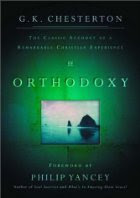
Have any of us read Orthodoxy by G.K. Chesterton? I am reading this book again (third or fourth time) because I feel my writing has stagnated. Oh I’m producing. I’m writing habitually. But something is stuck. Something in the writing isn’t moving. There is no reason to go out of my way (and out of my wits) to identify what that something is. These somethings happen to us all.
Anyhow. I won’t explain Orthodoxy or summarize it. (To do so would cheapen the experience of reading it for the first time.) Though I will leap into worthwhile passages that have helped me to understand more deeply the Process.
In "The Ethics of Elfland" Chesterton explains the difference between the Reasonable, Necessary logic of actions in actuality and the possibility of the same Reasonable, Necessary logic of actions in fairyland. He is explaining the relationship of what I call "Heart and Spine."
Spine: the structure of literal sense that is necessary for a reader to be able to read the story (analogous to Mathematics, or the Letter of the Law). Without Spine, the story cannot move; it is paralyzed. The narrative has no mobility, no legs to walk on, no arms to wave, no fingers with which to gesture. Without Spine, the processes necessary for a narrative body to do anything cannot happen.
Heart: the figurative and emotional sense that is necessary for a reader to be able to relate to the story (analogous to the Spirit of the Law). Without Heart, the story may as well be a technical schematic, a complex algebraic equation, a health insurance policy. Without Heart, the story lacks emotion as well as the means of carrying the weight of emotion through language.
"The test of fairyland [is] the test of the imagination" (69). For example: "The witch in a fairy tale says, ‘Blow the horn, and the ogre’s castle will fall’; but she does not say it as if it were something in which the effect obviously arose out of the cause. Doubtless she has given the advice to many champions, and has seen many castles fall, but she does not lose either her wonder or her reason. She does not muddle her head until it imagines a necessary mental connection between a horn and a falling tower."
In narrative, Heart embodies mystery. Spine does not. But Spine is necessary in order to understand the story at all. With paralysis the Heart may or may not go on beating; regardless, it is lost to us. When we read the story of a witch who tells a champion, "Blow a horn, and the ogre’s castle will fall", if we immediately stop to question the witch ("Why must the champion blow a horn? That doesn’t make sense. What he needs to do is raise an army, or find some way to trick the bastard, or hire someone else to do the dirty work...etc.), then we destroy the mystery. We rip the Heart out of the story and squeeze the life out of it. The witch’s advice is part of the mystery. The witch herself is part of the mystery. No one can explain it definitively. There is no denotation. You can define what mystery itself is, but you cannot explain any given mystery. That is the Heart of a story. The Thing-in-Itself cannot be explained. And of course, if we rip out the Heart, the Spine becomes a mere spine, a structure without purpose. A structure for the sake of itself. Of what use is such a thing?
Onward.
Have any of us read Orthodoxy by G.K. Chesterton? I am reading this book again (third or fourth time) because I feel my writing has stagnated. Oh I’m producing. I’m writing habitually. But something is stuck. Something in the writing isn’t moving. There is no reason to go out of my way (and out of my wits) to identify what that something is. These somethings happen to us all.
Anyhow. I won’t explain Orthodoxy or summarize it. (To do so would cheapen the experience of reading it for the first time.) Though I will leap into worthwhile passages that have helped me to understand more deeply the Process.
In "The Ethics of Elfland" Chesterton explains the difference between the Reasonable, Necessary logic of actions in actuality and the possibility of the same Reasonable, Necessary logic of actions in fairyland. He is explaining the relationship of what I call "Heart and Spine."
Spine: the structure of literal sense that is necessary for a reader to be able to read the story (analogous to Mathematics, or the Letter of the Law). Without Spine, the story cannot move; it is paralyzed. The narrative has no mobility, no legs to walk on, no arms to wave, no fingers with which to gesture. Without Spine, the processes necessary for a narrative body to do anything cannot happen.
Heart: the figurative and emotional sense that is necessary for a reader to be able to relate to the story (analogous to the Spirit of the Law). Without Heart, the story may as well be a technical schematic, a complex algebraic equation, a health insurance policy. Without Heart, the story lacks emotion as well as the means of carrying the weight of emotion through language.
"The test of fairyland [is] the test of the imagination" (69). For example: "The witch in a fairy tale says, ‘Blow the horn, and the ogre’s castle will fall’; but she does not say it as if it were something in which the effect obviously arose out of the cause. Doubtless she has given the advice to many champions, and has seen many castles fall, but she does not lose either her wonder or her reason. She does not muddle her head until it imagines a necessary mental connection between a horn and a falling tower."
In narrative, Heart embodies mystery. Spine does not. But Spine is necessary in order to understand the story at all. With paralysis the Heart may or may not go on beating; regardless, it is lost to us. When we read the story of a witch who tells a champion, "Blow a horn, and the ogre’s castle will fall", if we immediately stop to question the witch ("Why must the champion blow a horn? That doesn’t make sense. What he needs to do is raise an army, or find some way to trick the bastard, or hire someone else to do the dirty work...etc.), then we destroy the mystery. We rip the Heart out of the story and squeeze the life out of it. The witch’s advice is part of the mystery. The witch herself is part of the mystery. No one can explain it definitively. There is no denotation. You can define what mystery itself is, but you cannot explain any given mystery. That is the Heart of a story. The Thing-in-Itself cannot be explained. And of course, if we rip out the Heart, the Spine becomes a mere spine, a structure without purpose. A structure for the sake of itself. Of what use is such a thing?
2009/03/05
Goddamn Jackrabbits
This semester I teach four stories: Joy Williams’ Taking Care; Mark Richard’s Strays; Sherman Alexie’s This Is What It Means to Say Phoenix, Arizona; and Denis Johnson’s Emergency.
What do these stories have in common (aside from how much I love them)?
Except for Strays, there is a scene in each story, in which two characters are riding together in a car and either witness or cause the death of a rabbit. (In Strays, there is "an exploded chicken in the grill of Uncle Trash’s car." Similar, yet so very different.)
How does the same fundamental scene appear in three different stories? In Taking Care, Jones is driving along with his granddaughter strapped into her carseat next to him. He sees a hare running through the snow. The next thing that happens, a hunter shoots the hare, which tumbles to a dead flop in the road. In Phoenix, Arizona, Thomas Builds-the-Fire takes over driving from Victor in the middle of the Nevada desert. Immediately, a long-eared jackrabbit dashes out in front of the pickup, and Thomas runs over it. The rabbit is "first living thing" they see in all of Nevada, and Thomas kills it. They are quick to tell each other that the jackrabbit’s death must have been suicide. In Emergency, Georgie the Orderly is driving along with the narrator, Fuckhead, sitting beside him. Georgie hit a rabbit. They didn’t notice right away. Georgie stopped, then "threw the truck in reverse" and "zigzagged back to rabbit, almost running over the poor animal a second time." We all know what Georgie did to the rabbit next.
So, what’s with the common scene? Why does it repeat itself in three different stories? Taking Care was published first, in the 1970s. Emergency second, though much later, in 1992. This Is What it Means to Say Phoenix, Arizona third, in 1993. This is a baffling sort of mystery, the running over of rabbits with vehicles in contemporary fiction. I have no explanation for this phenomenon. But I am curious to find other examples of the same scene.
What do these stories have in common (aside from how much I love them)?
Except for Strays, there is a scene in each story, in which two characters are riding together in a car and either witness or cause the death of a rabbit. (In Strays, there is "an exploded chicken in the grill of Uncle Trash’s car." Similar, yet so very different.)
How does the same fundamental scene appear in three different stories? In Taking Care, Jones is driving along with his granddaughter strapped into her carseat next to him. He sees a hare running through the snow. The next thing that happens, a hunter shoots the hare, which tumbles to a dead flop in the road. In Phoenix, Arizona, Thomas Builds-the-Fire takes over driving from Victor in the middle of the Nevada desert. Immediately, a long-eared jackrabbit dashes out in front of the pickup, and Thomas runs over it. The rabbit is "first living thing" they see in all of Nevada, and Thomas kills it. They are quick to tell each other that the jackrabbit’s death must have been suicide. In Emergency, Georgie the Orderly is driving along with the narrator, Fuckhead, sitting beside him. Georgie hit a rabbit. They didn’t notice right away. Georgie stopped, then "threw the truck in reverse" and "zigzagged back to rabbit, almost running over the poor animal a second time." We all know what Georgie did to the rabbit next.
So, what’s with the common scene? Why does it repeat itself in three different stories? Taking Care was published first, in the 1970s. Emergency second, though much later, in 1992. This Is What it Means to Say Phoenix, Arizona third, in 1993. This is a baffling sort of mystery, the running over of rabbits with vehicles in contemporary fiction. I have no explanation for this phenomenon. But I am curious to find other examples of the same scene.
2009/03/04
VERBS
You who have read my stories know how much I love verbs. Verbs make a story go. The right verb at the right moment is like a small magical explosion, or a glamer of gnomic wizardry, or a burst of forbidden fruit on your tongue.
There are two stories in particular (neither of which are mine) that make especial use of verbs: Steve Almond’s My Life in Heavy Metal (sensory verbs) and Leonard Michaels’ The Deal (action verbs). I’ll start with Mr. Almond.
Now on to Mr. Michaels (I didn’t keep track of page numbers):
Jammed. Poked. Tucked. Cut. Rode. Slipped. Cracked. Plucked. Looped. Tipped. Nudged. Tilted. Swelled. Yowled. Swivelled. Snapped. Hooked. Cackled. Swept. Steeped. Trotted. Sprayed. Banged.
The verbs in this story wield hard edges. Hard edges and small motions, almost twitch-like in their animation. Which works, because the antagonist(s) is "a raggedy monster of boys", twenty boys total, "jammed together on the stoop." Yowled? That’s the verb used to describe a truck’s gears shifting. Steeped? "The sun was low above the river and the street three quarters steeped in shade." Lovely. After being drenched in summer sun all day, the street is almost relieved to be soaked in shade, itself like water. The angle of light is steeper than the angle of the street, and the shade is now thick, as if one could walk up the incline. Beautiful!
If we haven’t read The Deal, ask me for a copy and I will supply one. (Mr. Camel Cricket has read it. He knows what I’m talking about.)
There are two stories in particular (neither of which are mine) that make especial use of verbs: Steve Almond’s My Life in Heavy Metal (sensory verbs) and Leonard Michaels’ The Deal (action verbs). I’ll start with Mr. Almond.
wag (pp. 1): to walk suggestively; said of the narrator’s fiancé
punch (2): the effect of a powerful odor; in this case, lard used in Mexican cooking
glow (2): said of lighted swimming pools; "glowed like sapphires"
bang out (3): to type against a deadline
blossom (4): said of the effect when the Mexican lifeguard switches from English to her native tongue, Spanish
dance (4): said of the tongue moving against teeth (linked to the example of ‘blossom’)
vault (7): the motion of a woman’s pelvis moving suddenly upward at orgasm
beard (23): wrapped, or enveloped, in an odor; "bearded in the smell of Claudia"
More examples lie scattered throughout the story, but I find these in particular impressive. Almond’s use of verbs in this manner gets me thinking about how I use verbs. How might I describe, say, the feel and taste of capsaicin on a character’s tongue? Rather than saying something like "The hot pepper set his tongue on fire" or "...burned his tongue" or "tingled intolerably" (geez, that last one), I would try to find a sensory verb that does the job in an unexpected-yet-fitting way....Of course nothing comes to mind immediately. It’s hard to do. I’ll figure it out.
Now on to Mr. Michaels (I didn’t keep track of page numbers):
Jammed. Poked. Tucked. Cut. Rode. Slipped. Cracked. Plucked. Looped. Tipped. Nudged. Tilted. Swelled. Yowled. Swivelled. Snapped. Hooked. Cackled. Swept. Steeped. Trotted. Sprayed. Banged.
The verbs in this story wield hard edges. Hard edges and small motions, almost twitch-like in their animation. Which works, because the antagonist(s) is "a raggedy monster of boys", twenty boys total, "jammed together on the stoop." Yowled? That’s the verb used to describe a truck’s gears shifting. Steeped? "The sun was low above the river and the street three quarters steeped in shade." Lovely. After being drenched in summer sun all day, the street is almost relieved to be soaked in shade, itself like water. The angle of light is steeper than the angle of the street, and the shade is now thick, as if one could walk up the incline. Beautiful!
If we haven’t read The Deal, ask me for a copy and I will supply one. (Mr. Camel Cricket has read it. He knows what I’m talking about.)
2008/12/09
The End is Nigh!
Of the semester, I mean. . . .
Everywhere you go, people act out their holiday-induced neuroses through public spectacles. In stores children are screaming. At Wal-Mart the air is rife with burning indifference for your fellow man. But enough about that.
One of my purposes in life, I've discovered, is to understand what bizarre energy is at work in the fiction of Joy Williams. I have read each of her three story collections (Taking Care, Escapes, and Honored Guest) and two of her novels (The Changeling and The Quick and the Dead). I cannot say I dislike any of it. Not one story would I qualify in a negative light. And I won't comment on The Changeling here (I don't think I could). But The Quick and the Dead merits further attention. What on earth is this novel doing? It seems to lack any plot. Or it has just enough plot to move. Enough plot, as John Edgar Wideman says, "to hang the meat from." I have read nothing else that is so utterly bizarre yet so completely engrossing.
My mind slipped. I forgot where I was going with this. More later.
Everywhere you go, people act out their holiday-induced neuroses through public spectacles. In stores children are screaming. At Wal-Mart the air is rife with burning indifference for your fellow man. But enough about that.
One of my purposes in life, I've discovered, is to understand what bizarre energy is at work in the fiction of Joy Williams. I have read each of her three story collections (Taking Care, Escapes, and Honored Guest) and two of her novels (The Changeling and The Quick and the Dead). I cannot say I dislike any of it. Not one story would I qualify in a negative light. And I won't comment on The Changeling here (I don't think I could). But The Quick and the Dead merits further attention. What on earth is this novel doing? It seems to lack any plot. Or it has just enough plot to move. Enough plot, as John Edgar Wideman says, "to hang the meat from." I have read nothing else that is so utterly bizarre yet so completely engrossing.
My mind slipped. I forgot where I was going with this. More later.
2008/11/24
Brilliance
Yes:
"The power of [writing] exercises depends on recognition of the value of teaching form, not 'expression.' I believe that unless and until reading and writing are taught together--and are taught together with discussion--there will be little chance that English departments will survive as anything but outposts of sociology. But teaching writing as a way of learning to read and reading closely as a model for careful writing is to guide students to the discovery of the powers of language: should that not be the chief mission of any and all English departments? . . . . Anyone we read with pleasure can help us to teach others to read with pleasure. If we do not aim for instruction and delight, those Horatian values will forever elude us."
(Ann E. Berthoff)
And this one, what brilliance:
"Read it as if it made sense and perhaps it will."
(I.A. Richards)
"The power of [writing] exercises depends on recognition of the value of teaching form, not 'expression.' I believe that unless and until reading and writing are taught together--and are taught together with discussion--there will be little chance that English departments will survive as anything but outposts of sociology. But teaching writing as a way of learning to read and reading closely as a model for careful writing is to guide students to the discovery of the powers of language: should that not be the chief mission of any and all English departments? . . . . Anyone we read with pleasure can help us to teach others to read with pleasure. If we do not aim for instruction and delight, those Horatian values will forever elude us."
(Ann E. Berthoff)
And this one, what brilliance:
"Read it as if it made sense and perhaps it will."
(I.A. Richards)
2008/11/22
Process IV
Have you ever watched a cat play with a suction cup? Have you ever taken a shower with someone who had been mauled by a tiger? Have you ever felt exceedingly jealous of a person many years dead? [Albert Einstein watches over my office from the door and from the posterboard. Is it possible for a person alive today to feel jealousy toward Albert Einstein, for whatever reason, even though he has been dead since April 18, 1955?]
---
Some gems from the book Forming / Thinking / Writing: The Composing Imagination by Ann E. Berthoff.
"Having the capacity to understand means having the capacity to misunderstand."
"Language is not a set of pigeon holes into which we put things, ideas, feelings. We discover meanings in the process of working (and playing) with the means language provides."
"The aim of composing is not to tolerate chaos for its own sake but to learn to put up with it while you discover ways of emerging."
And a quote, by Mary Shelley, that the author uses: "Invention consists in the capacity of seizing on the capabilities of a subject and in the power of moulding and fashioning ideas suggested to it."
---
Some gems from the book Forming / Thinking / Writing: The Composing Imagination by Ann E. Berthoff.
"Having the capacity to understand means having the capacity to misunderstand."
"Language is not a set of pigeon holes into which we put things, ideas, feelings. We discover meanings in the process of working (and playing) with the means language provides."
"The aim of composing is not to tolerate chaos for its own sake but to learn to put up with it while you discover ways of emerging."
And a quote, by Mary Shelley, that the author uses: "Invention consists in the capacity of seizing on the capabilities of a subject and in the power of moulding and fashioning ideas suggested to it."
2008/11/18
What can you read over and over again?
Every short story in each of Joy Williams' three collections.
Martin Amis' Time's Arrow and Einstein's Monsters.
Padgett Powell's short stories (most of them but not all of them).
G.K. Chesterton's Orthodoxy.
Martin Amis' Time's Arrow and Einstein's Monsters.
Padgett Powell's short stories (most of them but not all of them).
G.K. Chesterton's Orthodoxy.
2008/10/20
WEBLOG: a log with a spider's web on it
First new post in nearly a month. Why are we so goddamn busy? How come each semester has its own bizarre theme? I still don't care one bit for T.S. Eliot or Ezra Pound. I still haven't read "Moby Dick." I would still like to have a standing table constructed. I've blazed through three pads of yellow paper since August and each draft I've written feels incomplete, flawed, gangly, or sideways. I now enjoy W.S. Merwin's poetry. And Charles Baxter's novel "First Light" (it moves backward). I need a secretary.
Liz and I celebrated our 6th wedding anniversary on the 19th.
Liz and I celebrated our 6th wedding anniversary on the 19th.
2008/09/20
ecneicsinmO
I've been trying not to think too hard about this lately. Omniscient narration and how it's so difficult to write it. A narrator who knows all seems excessive. Too much information is at my disposal.
An omniscient narrator knows not everything; an omniscient narrator knows from the onset what is not necessary to the narrative. That helps no one, I know. But my approach lately has been to abandon things I don't need for a given story. This is old advice: "Any one setting out to dispute anything ought always to begin by saying what he does not dispute. Beyond stating what he proposes to prove he should always state what he does not propose to prove." (G.K. Chesterton)
In a way I'm working backward. I find it helpful to work backward. Narrative in reverse cannot move without going forward at the same time, otherwise it makes no sense. (See Martin Amis's novel Time's Arrow.) So I begin with an idea for a story, a vague idea that I imagine will move forward in X, Y, or Z manner. At the same time I establish what the story does not need, and the story now cannot move forward in Y or Z manner. The omniscient narrator knows now of something that the story does not need. I feel as though I'm running in a circle with this. Goddammit, I'll make it clear one of these days. It's a bit humbling to lay out my thought process for anyone to read. Oh well. I can see every possible beginning from the single end.
An omniscient narrator knows not everything; an omniscient narrator knows from the onset what is not necessary to the narrative. That helps no one, I know. But my approach lately has been to abandon things I don't need for a given story. This is old advice: "Any one setting out to dispute anything ought always to begin by saying what he does not dispute. Beyond stating what he proposes to prove he should always state what he does not propose to prove." (G.K. Chesterton)
In a way I'm working backward. I find it helpful to work backward. Narrative in reverse cannot move without going forward at the same time, otherwise it makes no sense. (See Martin Amis's novel Time's Arrow.) So I begin with an idea for a story, a vague idea that I imagine will move forward in X, Y, or Z manner. At the same time I establish what the story does not need, and the story now cannot move forward in Y or Z manner. The omniscient narrator knows now of something that the story does not need. I feel as though I'm running in a circle with this. Goddammit, I'll make it clear one of these days. It's a bit humbling to lay out my thought process for anyone to read. Oh well. I can see every possible beginning from the single end.
Subscribe to:
Posts (Atom)
A Slowly Growing List of Things to Look Forward To When You Have a Child
- Every day is either Christmas or Halloween or Birthday or Easter
- Leave those cats alone! They're going to scratch you and it will hurt
- You cannot lie under circumstances, but nor can you tell the literal truth
- Geez that kid is sharp
- Can I have cake? Can I have cake? Can I have cake? Huh? Daddy? Can I have cake?
- For the last time, stop asking me!
- Noticing the growth: taller and a bit heavier to carry
- Children's television shows
- Food. Wasted food
- Remembering that you once acted this way yourself
- Watching where the both of you are going
- The joy of hearing the word "fuck" being used experimentally, and justifying this experimentation by saying "Well they learn it eventually"
- TANTRUMS
- Sitting down together on the living room floor, a mess of blocks & cars & plush Care Bears strewn around you, discussing the complexities of each car's identity, its name, and why it is so humorous
- Having to take responsibility for someone else for a change
- More frustration than you're prepared for
- Wicked cackling
- Drawings of potato guys
- Learning about the world all over again
- Circular Logic
- Unexpected hugs and words put beautifully together out of context
- Waking up after 4 hours of sleep, and unexpectedly having to confront shit, in more than one place, including the carpet, a big toe, a butt, a bed, a toilet seat, and underpants