2009/03/22

Not ick; more of a Why-would-you-want-to?


After we get our eyeballs tattooed, we can all go out and have ringlets pierced into our backfat. Look at the pretty pink lace! It's all the rage in England, apparently. One more artifice on which errant hooks may snag.

Oh ick, ick, ick


This is not a horror movie still. This is actual eyeball tattooing. This is actual eyeball tattooing. I cannot say why I am so obsessively repulsed by this and yet keep coming back to it. There is no reason. But I had to share the image with everyone.

2009/03/18

Distraction, Heart . . . Writings from Nine Months Ago

Characters who suffer Distraction may know full well in what they invest their attention. Consider the slipperiness of prepositions: do characters suffer from Distraction or with Distraction or because of Distraction? Similarly, are characters themselves the source of Distraction or the victims of Distraction or is Distraction something (at? to? on? in? for? by? toward? through? across?) which characters give attention?

I should pay attention to Distraction, not to distractions, in whatever form they manifest, but to Distraction itself.
*
How can one distract one's distraction?
*
Distraction. Loss. A sense of outrage. An inability to think rationally and clearly. A grasping at quick fixes that do not fix, and are not quick. A demand for immediate satisfaction of desires, of wants, of success. (Does desire know only gift and theft?) The chasing of happiness, when happiness itself is unknown and undefinable. What the hell is it? "Happy" cannot exist as a verb. It needs a helper: to make, to be, to become. Or it needs an active verb: to pursue, to chase, to grab, to forget, etc.
*
What about thumbtacks? The empty aquarium? The lava lamp that’s missing its base? What things have Heart? Does a bead have Heart? A bead has Heart. A bead’s heart is its hole, through which a twine strings together one bead with other beads, a string of Heart. A bead without its hole is not a bead, but a marble, a pebble, a bit of glass, something else. But not a bead.
---
Absence is Heart. A treasure ceases to be treasure once it is no longer valued. An empty aquarium, aquarium though it may be, contains absence, it contains something that is not there. A shoe without a foot. A ring without a finger. A day without pain.
---
Does a gun have a Heart? Does a bullet count? Does a will, a want, a desire? Is there Heart in an action: picking up a gun in a moment of passion? Throwing down a gun before a fight has begun? Agreement to the use of force by action of the force itself. Disagreement to the use of force by action of dropping the gun. Is there Heart in fear? Fear that is felt by bystanders, preservation, an impulse not toward action but toward words, paralysis. Prayer? Is prayer action or words or both?
---
In Heart lies desire. What truth is in the statement "Desire knows only theft and gift"? What does Heart know? Does Heart know theft? Gift? Absence? Does the hole through a bead desire twine?
---
"So What?" and "Defamiliarization" share something in common. What is it? A new perspective of an old thing. A different understanding of something thoroughly understood. A sensory experience of something that offers no sensory stimulation.
---
What am I seeking? The language of excess. The language of distraction. The language of stories, and myths, and narratives. The language to move readers. The language to argue, to convey, to understand, to escape. The language of characterization.
---
Listen to the background noise, the hiss and chime behind vertical surfaces. What do you hear? How do you hear it?

2009/03/11

Spine & Heart (Process VIII)

I am agreeable to a fantastic story. Ten years I spent playing Dungeons & Dragons, among other role-playing games. Now I’m not too surprised about having gone on study stories in college (and if I had more time, I’d be playing those games in my spare hours). Dungeons & Dragons allows a small group to create individual characters who interact with a fictional world. It is, quite simply, world-building & characterization & plot development & narrative structure & willing suspension of disbelief all wrapped together in an ongoing storyline with numerous minor storylines branching off and back again over an extended period of time. Almost invariably I served as "game master." The world was my own. All things and creatures and personae and Gods and characters (except for the players’ characters) were my own. It is a living thing. It has voice and reason, myth and tales, heroes and dragons. It is a place of horrible violence where bad things happen to good people and good things happen to bad people. As it must necessarily be so. And, it was good practice.

Onward.

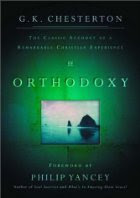
Have any of us read Orthodoxy by G.K. Chesterton? I am reading this book again (third or fourth time) because I feel my writing has stagnated. Oh I’m producing. I’m writing habitually. But something is stuck. Something in the writing isn’t moving. There is no reason to go out of my way (and out of my wits) to identify what that something is. These somethings happen to us all.

Anyhow. I won’t explain Orthodoxy or summarize it. (To do so would cheapen the experience of reading it for the first time.) Though I will leap into worthwhile passages that have helped me to understand more deeply the Process.

In "The Ethics of Elfland" Chesterton explains the difference between the Reasonable, Necessary logic of actions in actuality and the possibility of the same Reasonable, Necessary logic of actions in fairyland. He is explaining the relationship of what I call "Heart and Spine."

Spine: the structure of literal sense that is necessary for a reader to be able to read the story (analogous to Mathematics, or the Letter of the Law). Without Spine, the story cannot move; it is paralyzed. The narrative has no mobility, no legs to walk on, no arms to wave, no fingers with which to gesture. Without Spine, the processes necessary for a narrative body to do anything cannot happen.

Heart: the figurative and emotional sense that is necessary for a reader to be able to relate to the story (analogous to the Spirit of the Law). Without Heart, the story may as well be a technical schematic, a complex algebraic equation, a health insurance policy. Without Heart, the story lacks emotion as well as the means of carrying the weight of emotion through language.

"The test of fairyland [is] the test of the imagination" (69). For example: "The witch in a fairy tale says, ‘Blow the horn, and the ogre’s castle will fall’; but she does not say it as if it were something in which the effect obviously arose out of the cause. Doubtless she has given the advice to many champions, and has seen many castles fall, but she does not lose either her wonder or her reason. She does not muddle her head until it imagines a necessary mental connection between a horn and a falling tower."

In narrative, Heart embodies mystery. Spine does not. But Spine is necessary in order to understand the story at all. With paralysis the Heart may or may not go on beating; regardless, it is lost to us. When we read the story of a witch who tells a champion, "Blow a horn, and the ogre’s castle will fall", if we immediately stop to question the witch ("Why must the champion blow a horn? That doesn’t make sense. What he needs to do is raise an army, or find some way to trick the bastard, or hire someone else to do the dirty work...etc.), then we destroy the mystery. We rip the Heart out of the story and squeeze the life out of it. The witch’s advice is part of the mystery. The witch herself is part of the mystery. No one can explain it definitively. There is no denotation. You can define what mystery itself is, but you cannot explain any given mystery. That is the Heart of a story. The Thing-in-Itself cannot be explained. And of course, if we rip out the Heart, the Spine becomes a mere spine, a structure without purpose. A structure for the sake of itself. Of what use is such a thing?

2009/03/08

So long, house & a Catnip Orgy


Controlled Burn at the corner of Fairfield & James.


. . . as seen through the trees.


CATNIP ORGY!


. . . Resting after the seizure by Dionysus.

2009/03/05

Something To Do

Everyone should prepare a list of nonsense. Listen to people at the store or the mall or the Student Union. Make a list of all the weird, odd, bizarre, unintelligible, decontextualized garbage they say to each other or into their phones. Look at Farm-and-Fleet catalogs and imagine the possibilites in what they sell. Browse the Yellow Pages index for jobs. These people actually specialize! Lawn Maintenance! Bolts & Nuts! Magicians! Mattresses, Meat Processors, Quilters! Weight Control Services! Flag Poles (and the subsequent entry, Polishing Equipment and Supplies)! Searchlights and Floodlights! Call these people. Ask them about their jobs. I'm sure they'd love to talk to you. I'm certain they'd love to tell you all about themselves and what they do. How many people watch Dirty Jobs these days? It's still on the air, right?

Goddamn Jackrabbits

This semester I teach four stories: Joy Williams’ Taking Care; Mark Richard’s Strays; Sherman Alexie’s This Is What It Means to Say Phoenix, Arizona; and Denis Johnson’s Emergency.

What do these stories have in common (aside from how much I love them)?

Except for Strays, there is a scene in each story, in which two characters are riding together in a car and either witness or cause the death of a rabbit. (In Strays, there is "an exploded chicken in the grill of Uncle Trash’s car." Similar, yet so very different.)

How does the same fundamental scene appear in three different stories? In Taking Care, Jones is driving along with his granddaughter strapped into her carseat next to him. He sees a hare running through the snow. The next thing that happens, a hunter shoots the hare, which tumbles to a dead flop in the road. In Phoenix, Arizona, Thomas Builds-the-Fire takes over driving from Victor in the middle of the Nevada desert. Immediately, a long-eared jackrabbit dashes out in front of the pickup, and Thomas runs over it. The rabbit is "first living thing" they see in all of Nevada, and Thomas kills it. They are quick to tell each other that the jackrabbit’s death must have been suicide. In Emergency, Georgie the Orderly is driving along with the narrator, Fuckhead, sitting beside him. Georgie hit a rabbit. They didn’t notice right away. Georgie stopped, then "threw the truck in reverse" and "zigzagged back to rabbit, almost running over the poor animal a second time." We all know what Georgie did to the rabbit next.

So, what’s with the common scene? Why does it repeat itself in three different stories? Taking Care was published first, in the 1970s. Emergency second, though much later, in 1992. This Is What it Means to Say Phoenix, Arizona third, in 1993. This is a baffling sort of mystery, the running over of rabbits with vehicles in contemporary fiction. I have no explanation for this phenomenon. But I am curious to find other examples of the same scene.

2009/03/04

Gooooo . . . ooooogle

Gooooooooooooooooooooogle is now entwined, entangled, interwoven, admixed, enmeshed, knotted, tangled, zusammen, engaged with publishing and authors and (it appears) every book ever written and ever to be written, according to this article in the New York Times book review page.

VERBS

You who have read my stories know how much I love verbs. Verbs make a story go. The right verb at the right moment is like a small magical explosion, or a glamer of gnomic wizardry, or a burst of forbidden fruit on your tongue.

There are two stories in particular (neither of which are mine) that make especial use of verbs: Steve Almond’s My Life in Heavy Metal (sensory verbs) and Leonard Michaels’ The Deal (action verbs). I’ll start with Mr. Almond.

wag (pp. 1): to walk suggestively; said of the narrator’s fiancĂ©
punch (2): the effect of a powerful odor; in this case, lard used in Mexican cooking
glow (2): said of lighted swimming pools; "glowed like sapphires"
bang out (3): to type against a deadline
blossom (4): said of the effect when the Mexican lifeguard switches from English to her native tongue, Spanish
dance (4): said of the tongue moving against teeth (linked to the example of ‘blossom’)
vault (7): the motion of a woman’s pelvis moving suddenly upward at orgasm
beard (23): wrapped, or enveloped, in an odor; "bearded in the smell of Claudia"

More examples lie scattered throughout the story, but I find these in particular impressive. Almond’s use of verbs in this manner gets me thinking about how I use verbs. How might I describe, say, the feel and taste of capsaicin on a character’s tongue? Rather than saying something like "The hot pepper set his tongue on fire" or "...burned his tongue" or "tingled intolerably" (geez, that last one), I would try to find a sensory verb that does the job in an unexpected-yet-fitting way....Of course nothing comes to mind immediately. It’s hard to do. I’ll figure it out.


Now on to Mr. Michaels (I didn’t keep track of page numbers):

Jammed. Poked. Tucked. Cut. Rode. Slipped. Cracked. Plucked. Looped. Tipped. Nudged. Tilted. Swelled. Yowled. Swivelled. Snapped. Hooked. Cackled. Swept. Steeped. Trotted. Sprayed. Banged.

The verbs in this story wield hard edges. Hard edges and small motions, almost twitch-like in their animation. Which works, because the antagonist(s) is "a raggedy monster of boys", twenty boys total, "jammed together on the stoop." Yowled? That’s the verb used to describe a truck’s gears shifting. Steeped? "The sun was low above the river and the street three quarters steeped in shade." Lovely. After being drenched in summer sun all day, the street is almost relieved to be soaked in shade, itself like water. The angle of light is steeper than the angle of the street, and the shade is now thick, as if one could walk up the incline. Beautiful!

If we haven’t read The Deal, ask me for a copy and I will supply one. (Mr. Camel Cricket has read it. He knows what I’m talking about.)

2009/03/02

Process...VII?

[A pair of mannequin legs floated by on the current, sticking straight up. A second pair followed the first, and a third in an upside-down kneel.]
*
What sort of character would concoct homemade napalm for use in booby traps?
*
Have you ever lived near an oxbow lake? An engine bloc depository? A rake forest? A place you could swim naked without fear of being seen?
*
Flute music will come through the wall from the neighbor's apartment. Someone above will be running a blender. You will be chopping a pineapple on the counter with too small a knife. You will not realize your sweater is backward. Later, your date will wonder where all these fleas came from, and you will hope the fleas have gone unnoticed.
*
[A writing challenge: "One character has an unexpected scar."]
*
If you take offense to Kong in Trowbridge's Complete Book of Kong, you're probably the kind of person Kong would squeeze too hard.
*
-spect-
spectate - respect - introspection - inspect -
spectral - specter - disrespect -
circumspect - [prespect] - underinspect -
overinspect - overcircumspection - subspect
*
It isn't that difficult. Do you understand it? Yes or No? Then, Why? and How? (yes or no . . .)
Small, local context? or Universal context?
-Does it matter?
-Don't do this, Don't do that, Avoid all advice good and bad.
Unless the advice works, or doesn't work.
*
Looking forward to going to bed.
*
I am fond of the word "malingerer". Self-abuse. Smacking.
*
"What's the limit on skulls this year?"
"Scram, you assholes."
"Blunt yourselves."
"PILED FOR QUALITY!"
"They hosted parasites."
"Do pugs bay?"
"The mayor's noose-"
"What about the mayor's noose?"
"Paw, as in 'grope.'"
*
Wooden Eyes.
*

2009/03/01

A Selection: 20 minutes of Elocution, by my Daughter

IT’S JUST A LETTER FOR MAMA. OH, THAT’S JUST MY TRUCK DOWN THERE. AND LOOK WHAT I MADE. IT’S CALLED THE FISH COLLECTION. IT LOOKS SO GREAT IN THIS. HERE’S THE CAR. HERE’S SOMETHING. WE ALWAYS HAVE SKIN. WE NEED TO HAVE DOG FOOD DOWN HERE. AND CAT FOOD. BABY, I’M GOING TO DECORATE IT WITH CLAM SHELLS. DON’T GET ANY IDEAS. GETTING UNDER MY SKIN! BOMBS AWAY! BOUNCE AWAY! OH, TAD, BACK SO SOON? BUT REMEMBER, WATCH OUT FOR THE GHOST OUTSIDE. IS IT TIME TO ROLL? NO, I’M STANDING ON THE TABLE BECAUSE IT’S FLYING. I SEARCH HIGH AND LOW. MY CAP. YOU MEAN THAT I’M TURNING MY ELBOWS BACKWARDS. YOU MEAN I HAVE NO HANDS. I HAVE NO ELBOWS LIKE AN ALIEN. IT LOOKS LIKE A BUBBLE. IF YOU TURN IT UPSIDE-DOWN IT LOOKS LIKE A BUBBLE. I DON’T WANT HIM. I WANT MY LITTLE DOG. I’LL BE RIGHT BACK INSIDE. WHEN I WAS SCRATCHING MY HAND . . . YUM. BACK SO SOON? HEY, MAKE THIS A RIVER! I’M LAUGHING IN THE RIVER! FIRST, WE GET TO SHARE THE PLAY-DOH. WELL LET’S PLAY BABIES RIGHT HERE. WE’RE HERE. PROFESSOR PICKLES. AND I’M PLAY-DOH KITTY. NO I’M PLAY-DOH DOG.
*
[Recorded by hand on the evening of 28 February, 2009. Medium: Crayola markers on yellow college-rule legal pad.]
*
You can't make this stuff up.

2009/02/28

panic

I have officially designated Saturday, August 8 as Comprehenesive Exam Panic Day (CEPD). I am not allowed to panic about the comps except on this arbitrarily designated day.

2009/02/25

Body, Ailment, Treatment; & Books

Extremities: fingers, toes, hands, feet, ears, nose. Neuropathy, poor circulation, numbness, injury, infection, gangrene. Amputations! [Phantom limb phenomenon; phantom pain.]

Moving on.

Kidneys: Corrosive damage by sustained hyperglycemia. Reduced kidney function, infections. Renal failure. Dialysis, transplant!

Moving on.

Pancreas: Doesn't work.

Moving on.

Eyes: Natural aging and wearing out. Corneal damage, retinal detachment. Burst blood vessels due to increased blood pressure, sustained hyperglycemia, eye trauma or injury. Poor vision in one or both eyes, decreasing in quality over time, eventual blindness in one or both eyes. Seeing-eye dog! Helper monkey!

Moving on.

Heart: Increased strain. Higher blood pressure. Sustained hyperglycemia leading to damage of the heart muscle. Circulatory system damage. Heart attack, stroke, leg clots. [!]
---
Curiosity has prodded me to buy two books recently:
Freaks: We Who Are Not As Others by Daniel P. Mannix
The Re/Search Guide to Bodily Fluids by Paul Spinrad

Those of us who have read Katherine Dunn's Geek Love understand "Freaks." Hardly a spectacle, this book is more of a look at the everyday lives of midgets, dwarves, hermaphrodites, giants, pinheads, half-people, the multi-legged, and the like. Maybe the Freaks are normal, and the normal people are the freaks.

Of course bodily fluids are disgusting. We remember Georgie the orderly from Denis Johnson's Emergency, don't we? "There's so much goop inside of us, man," he said, "and it all wants to get out." But who isn't curious? Who?

2009/02/22

Mornings / Strange Words

How I have missed the early hours. At one time, several years ago, I would go to bed at 8:00 or 9:00 in the evening and wake up at 2:00 or 3:00 in the morning, and write. I have spent much of the past year-and-a-half pursuing that schedule. I’m finally reclaiming it: up yesterday morning at 6:30. Up this morning at 5:45. My goal for tomorrow is up at 5:15. I would like to rise by 5:00 on Tuesday, Wednesday, and Thursday. Friday and Saturday, I will try 4:45.

What Julianna Baggott said about writing despite distractions (children, in particular) is very very very very true. We have to carve out our writing time with a fine blade. Free time? Time is what we make of it.

On a related note, I have successfully held, used, and kept a calendar book since February 13. Hooray. I think this is a new record.
---
flummox, v. colloq. or vulgar
[prob. of English dialectical origin; cf. flummocks to maul, mangle (Heref. Gloss. 1839), flummock slovenly person, also hurry, bewilderment, flummock to make untidy, disorder, to confuse, bewilder (see various E.D.S. glossaries, Heref., Glouc., S. Cheshire, Sheffield). The formation seems to be onomatopæic, expressive of the notion of throwing down roughly and untidily; cf. flump, hummock, dial. slommock sloven.]
1. transitive. To bring to confusion; to ‘do for’, cause to fail; to confound, bewilder, nonplus.
2. U.S. colloq. To ‘do up’.
3. intransitive. U.S. To give in, give up, collapse.


flummadiddle, n. U.S.
slang. Nonsense, humbug; also, something trivial or ridiculous.

2009/02/21

The Mold that Grows on the Mold

I would like to argue in favor of something awful, something without a vocal majority's support. Something that makes one into a social pariah. Something only the Bill of Rights protects. It's good practice. I want to argue on behalf of the funk that builds up on the inside of a garbage can. I want to know the pervert inside the bunny costume. I want to map out the underside of the underside. I want Charlton Heston and Ronald Reagan to crawl forth from their graves, gibbering and spitting, shaking their dessicated fists in righteous outrage. That kind of awful.

Any ideas?

2009/02/18

Yet Again More Words: Obsolete and/or Unexpected

strummel, n. slang. Obs.
1. Straw.
2. Hair.
3. Comb.: strummel-patch a., a contemptuous epithet for a person.


strumpet, v. Obs.
1. transitive. To bring to the condition of a strumpet.
2. To repute as a strumpet; to debase (a woman’s fame, name, virtue) to that of a strumpet.
3. intransitive. To strumpet it, to play the strumpet.
Hence strumpeting vbl.n.


studmuffin, n. slang (orig. U.S.)
A sexually attractive young man. Freq. humorous or ironic.


stuffage, n.
1. The act of stuffing or filling full; concr. the material with which a receptacle is stuffed.
2. Path. Obstructed condition, stoppage. Obs.


[Oxford English Dictionary Online]

Play Areas

In the mall there is a crossroads, between Barnes & Noble and Scheel’s, and in this crossroads there is a great circle. The circle has but one opening, an ingress point at which stands Dr. Bear in all its loveable menace. The bear wears a doctor’s coat but not pants. Just inside the circle, on either side of the opening, there are cubby holes, ostensibly for the storage of children’s footwear, and a single hand-sanitizer dispenser. Padded benches line the circle’s low wall most of the way around. The carpet is spongy, but firm. Around a necessary structural pillar a padded mat has been attached like a bootie. And of course the playthings themselves: an ambulance, a thermometer, a stethoscope, a blood pressure cuff, a Band-aid, a building in the likeness of the Mankato Clinic, and a teddy bear the size of a great big fat man. The playthings are made of a pliable material both soft and firm. Everything in the circle rebounds, with the exception of the cubby holes and the structural pillar itself.
Watching a rampage of children play in the arms of the circle is like looking into a moshpit from balcony seats, except no one is smoking cigarettes or drinking beer or wearing earplugs. Adults behave no differently from children as far as I can tell. The distinction is that adults have learned how to control themselves to various extents. Among children, drama unfolds quickly, plays itself out, and soon evolves into another game. Adults squeeze drama out of drama, drama out of rocks, drama out of thin air. It is refreshing how quick children are to judge, like cats. How many times has the play area carpet been puked on? The absence of visible stains suggests that puking incidents are quickly cleaned up, rarely happen in the play area, or do not happen in the play area.
My sister would tell you a story about me, when I was seven years old. I had just eaten a bowl of cherry cordial ice cream. I shouted, "I’m a human vacuum cleaner!" and instantly fell on the carpet in complete imitation of the vacuum cleaner. In a matter of seconds I had inhaled something, a piece of fluff or fuzz, on which I choked. Coughing didn’t help much, not right away. The fluff or fuzz stuck long enough to teach me a lesson, and then I threw up all the ice cream I had just eaten, on the carpet I was attempting to clean. Why am I telling you this?

2009/02/17

I’ll Show You Mine If You Show Me Yours

Over the past week I have been opening neglected folders on the computer, one of which bears the label Starts & Stops. The Date Modified column of the document files contained therein reveal that these gems come from that ancient epoch known as 2005 (though a few date to 2006 or 2007).

For example, the first document is titled A Frog and a Horse. I open it. What does the text say? "A Frog and a Horse." That’s it. I typed "A Frog and a Horse" into a word processor file, saved it, and have been toting it around since 12-16-06 10:38 AM.

Here is another excerpt, the opening lines of something titled Dirt Stew (05-10-07 12:49 PM):

Dad started the fight. He said Connie’s stew tasted like dirt.

Dad was Ed’s brother, and Connie was Ed’s wife. Ed glared across the table over the pot of stew at dad. ‘What?’ dad said. ‘I had better stew in the service.’

Connie had made the stew earlier that day, as soon as she found out that dad was coming over to talk. It wasn’t a holiday, merely june 12th, but it was the first time
in at least twenty years that dad and Ed willingly sat at the same table.
It has...potential? And here extracts from some kind of list I engineered and saved and never looked at again (02-06-06 8:20 AM):

  1. Do not pay any attention to grocery store tabloids. Celebrities are not generally interesting people.
  2. Swimming pools are not toilets.
  3. Think with your own brain, not with someone else’s brain.
  4. Surrender is an option, if you wish to.
  5. Do you ask questions?
  6. Go ahead and try it, you might like it.
  7. I am beginning to hear phrases such as "non-democratic totalitarian state" in mainstream media outlets.

Your guess is as good as mine. Nowadays any list I deem worth saving will almost assuredly be composed of nouns and verbs, broken bits of overheard conversations, impossible hypothetical arguments, unusual names; little of it will make sense.

Not Subtle Enough?

The previous post rather lacked subtlety, didn't it?

2009/02/15

Merken - To Notice...Subtle, Subtlety, etc.

Yesterday, February 14, marked a significant date: 8 years since Liz and I first met. Though not face-to-face. Our first contact with one another happened over the internet, in a chat room, and later progressed to letters in the mail and hours-long phone conversations. This went on for six months until we did meet in person, after I rode a Grayhound bus from Carbondale, IL to Austin, TX (a 23-hour trip). Someday I will write this story, but not today.
---

Recently I have thought about two questions, or rather, a question and a statement. (I don’t know why these have come to mind, they just kind of bubbled to the surface while I was taking a shower.) They are the sort of commentary one hears in workshops and in poor-quality reviews and criticism:

"It seems as though the author is trying to be subtle."
"What point is the author trying to make?"


How is subtlety a bad thing? When do authors write anything with a conscious desire to effect subtlety? Is a clear understanding of "subtle" (adjective) warranted? Should we sort through the word’s many denotations?

[Oxford English Dictionary]
1. Of thin consistency, tenuous; not dense, rarefied; hence, penetrating, pervasive or elusive by reason of tenuity (now chiefly of odors).
2. Of fine or delicate texture or composition (Obs. exc. Arch.). b. Of food: delicate, light. (Obs.)
3. Of small thickness or breadth; thin, slender, fine. (Obs.) b. Of a ship. (Obs.)
4. Finely powdered; (of particles) fine, minute. (Obs.)
5. Of immaterial things: not easily grasped, understood, or perceived; (Obs.:) intricate, abstruse. (Now merged in sense 6).
6. Fine or delicate, especially to such an extent as to elude observation or analysis.
7. Of craftsmen, etc.: Skillful, clever, expert, dextrous. (Const. of) arch. b. transf. c. Of animals. rare.
8. Of things: characterized by cleverness or ingenuity of conception of execution; cleverly designed or executed, artfully contrived. (Obs.)
9. Of persons, their faculties, actions: Characterized by penetration, acumen, or discrimination. Now with implication of (excessive) refinement or nicety of thought, speculation, or argument.
10. Of persons or animals: Crafty, cunning; treacherously or wickedly cunning, insidiously sly, wily. (Obs.) b. Of actions, thoughts, etc. (Obs.) c. Of ground: tricky. (Obs.)
11. Working imperceptibly or secretly, insidious.
12. Of weight: = subtile (Obs.)

Also, "Subtlist" (noun):

One who is addicted to subtleties.

Also, "Subtlize" (verb):

Rare. Intransitive. To indulge in subtleties.

Ah, the verb "(to) subtle" (Obs.):

1. Reflexive and Intransitive. To devise subtleties or subtle distinctions, to argue subtly.
2. Intransitive. To scheme, plan craftily. Also with clause.
3. Transitive. To devise cleverly.
4. To attenuate, reduce.
5. ? To pulverize, reduce to ashes. nonce-use.

I understand that what I am doing is devising subtleties and making subtle distinctions; I am also, perhaps, indulging in subtleties. But how is "subtle" a word to be used in a pejorative sense? How?
---
"Subtle" cannot be subtle with a b.

A Slowly Growing List of Things to Look Forward To When You Have a Child

  • Every day is either Christmas or Halloween or Birthday or Easter
  • Leave those cats alone! They're going to scratch you and it will hurt
  • You cannot lie under circumstances, but nor can you tell the literal truth
  • Geez that kid is sharp
  • Can I have cake? Can I have cake? Can I have cake? Huh? Daddy? Can I have cake?
  • For the last time, stop asking me!
  • Noticing the growth: taller and a bit heavier to carry
  • Children's television shows
  • Food. Wasted food
  • Remembering that you once acted this way yourself
  • Watching where the both of you are going
  • The joy of hearing the word "fuck" being used experimentally, and justifying this experimentation by saying "Well they learn it eventually"
  • TANTRUMS
  • Sitting down together on the living room floor, a mess of blocks & cars & plush Care Bears strewn around you, discussing the complexities of each car's identity, its name, and why it is so humorous
  • Having to take responsibility for someone else for a change
  • More frustration than you're prepared for
  • Wicked cackling
  • Drawings of potato guys
  • Learning about the world all over again
  • Circular Logic
  • Unexpected hugs and words put beautifully together out of context
  • Waking up after 4 hours of sleep, and unexpectedly having to confront shit, in more than one place, including the carpet, a big toe, a butt, a bed, a toilet seat, and underpants